

Good sleeping habits for your back

Millions of people in the UK experience back pain every year. This can affect your ability to work, exercise, and enjoy life. But you don’t have to put up with this common condition. Did you know that by making lifestyle changes, such as the way you sleep, you can improve the health of your back? Here, I’ll discuss the best sleeping postures to reduce back pain.

What are good sleeping habits for your back?
There are several habits and lifestyle changes that can reduce your risk of back pain and help to improve symptoms of a weak or stiff back. Below I will discuss some of the best sleeping positions for back health. But there are other sleeping habits you can try as well. These include the following.
1) Try to manage your stress levels
We all feel stressed from time to time. But ongoing stress can increase muscle tension. This can include your lower and upper back. Going to bed stressed can reduce the quality of your sleep which may make pain worse. And tense muscles can make it uncomfortable to lie down. Try to take some time to unwind before bed. You could try taking a few deep, slow breaths, or doing some gentle stretching. Some people find a warm bath can reduce stress too.
2) Set your bed up for good sleep
Physiotherapists suggest choosing a medium – firm mattress that is both supportive and comfortable. But everybody is different – find what works for you. Experiment with the number of pillows you use – the right amount for you will depend on your shoulder width, sleeping position and personal choice. Some people find an orthopaedic pillow to support the neck and head better.
3) Stay active during the day
Sometimes having back pain can prevent you from working out. But building a strong core and increasing your mobility can reduce pain in the long run. Pilates can be very useful for back pain, as can stretching and building strength safely. Staying active during the day can also improve your sleep and reduce stress. Try to move little and often and avoid long periods of sitting.
4) Consider your posture
Spending lots of time sitting down during the day can make you stiff and uncomfortable at bedtime. If you work at a desk, ensure you are set up correctly with your PC at the right height. You need to keep your spine straight and supported, so consider a lower back support if necessary. You can also alternate standing and sitting to reduce the pressure on your spine.
How can you sleep with good back posture?
Sleeping with good posture at night can improve how well you sleep. It can also reduce any stress and strain on your back – which may help with pain and stiffness in the morning. For example, stomach sleeping can cause back pain if done incorrectly, but with a few tweaks can be made more comfortable. Sometimes using pillows as extra support can reduce the pressure on your spine.
What is the healthiest way to sleep for your back?
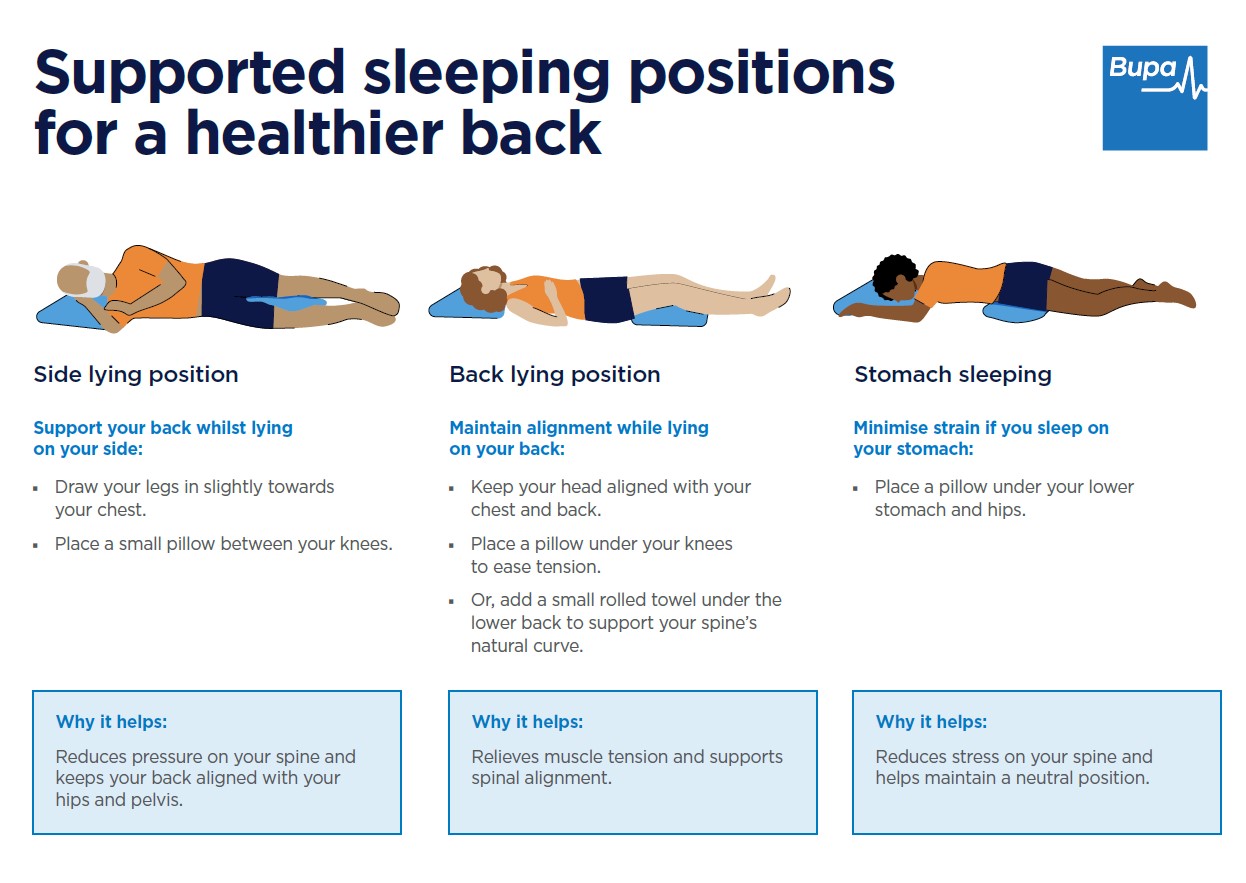
There is no one single best posture to sleep in. The best position for you and your back will depend on any specific back conditions you have, as well as what feels most comfortable. But there are three main positions for a healthy back that you can try, to see if they work for you.
Supported side lying position
If you prefer sleeping on your side, there are ways to make this more back friendly. Start by drawing your legs in slightly towards your chest and place a small pillow between your knees. This should reduce some of the pressure on your spine. It will also help to align your back with your hips and pelvis.
Back lying position
If you are happier lying on your back, you can reduce your risk of tension by using a pillow under your knees. This can help to relax tight back muscles. Keeping your neck aligned with your chest and back can help in this position. A small, rolled towel under the lower back will also support the curve of your spine.
Stomach sleeping
Ideally you would choose a back lying or side lying position for your back health. But if you sleep better on your stomach, it’s important to reduce any extra strain on your spine in this pose. One way to reduce stress on your back here is to place a pillow under your lower stomach and hips.
Back pain can be uncomfortable. While there isn’t one specific perfect sleeping position, experimenting with supports, and different positions can reduce back strain and make sleeping more comfortable.
Manage back pain with expert guidance
Follow our expert-led exercises and tips to manage discomfort and improve your mobility. Go to Wellbeing in the My Bupa app to start your step-by-step plan.
-
Sources Sources
- Good sleep guide. Chartered society of Physiotherapy. Csp.org.uk, accessed August 2025.
- Radwan A, Fess P, James D, et al. Effect of different mattress designs on promoting sleep quality, pain reduction, and spinal alignment in adults with or without back pain; systematic review of controlled trials. Sleep Health. 2015;1(4):257-267. doi: 10.1016/j.sleh.2015.08.001
- Vlaeyen JWS, Linton SJ. Fear-avoidance and its consequences in chronic musculoskeletal pain: a state of the art. Pain. 2000 ;85(3):317-332. doi: 10.1016/S0304-3959(99)00242-0
- Overview, low back pain and sciatica in over 16s: assessment and management. NICE guidelines. Nice.org.uk, last updated December 2020.
- Back pain nation: 49 million people in the UK struggling with back pain. British chiropractic association.chriopractic-uk.co.uk, accessed August 2025.
About our health information
At Bupa we produce a wealth of free health information for you and your family. This is because we believe that trustworthy information is essential in helping you make better decisions about your health and wellbeing.
Our information has been awarded the PIF TICK for trustworthy health information.

More general health advice articles



Did you find our advice helpful?
We’d love to hear what you think. Our short survey takes just a few minutes to complete and helps us to keep improving our healthy lifestyle articles.
Legal disclaimer
This information was published by Bupa's Health Content Team and is based on reputable sources of medical evidence. It has been reviewed by appropriate medical or clinical professionals and deemed accurate on the date of review. Photos are only for illustrative purposes and do not reflect every presentation of a condition.
Any information about a treatment or procedure is generic, and does not necessarily describe that treatment or procedure as delivered by Bupa or its associated providers.
The information contained on this page and in any third party websites referred to on this page is not intended nor implied to be a substitute for professional medical advice nor is it intended to be for medical diagnosis or treatment. Third party websites are not owned or controlled by Bupa and any individual may be able to access and post messages on them. Bupa is not responsible for the content or availability of these third party websites. We do not accept advertising on this page.