

Talent management
Connection crisis: 12 tips for team building and recapturing culture

Trish Donoghue, Employee Engagement and Experience Manager, Bupa UK, explores our research on disconnection within the UK’s working population. Here, we offer advice for managers on effective team building and getting your company culture back.
Your Google searches: Team connection
Our internal analysis of UK Google searches highlights concerns from UK business owners about connections between their team members. Comparing March 2025 search volumes with March 2024 volumes, we found a huge uplift in team building exercises:
- ‘Event organiser team building’ – 26 times as many searches
- ‘Team building services’ – 21 times as many searches
- ‘Outdoor team building activities for adults’ – 11 times as many searches
- ‘Virtual team building ideas’ – 10 times as many searches
- ‘Outdoor corporate events’ – Seven times as many searches
- ‘Indoor team building events’ - Seven times as many searches
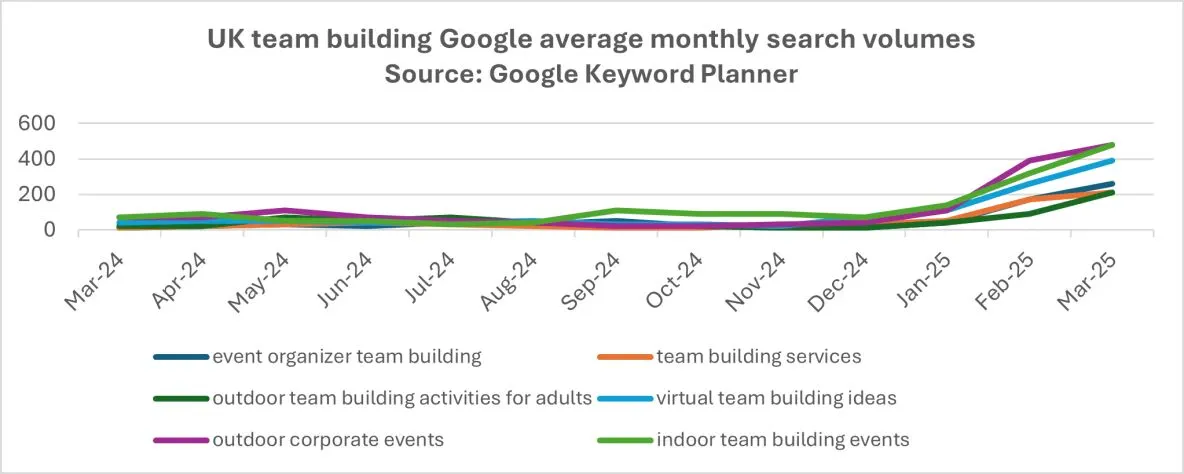
Our research nods to a growing disconnection between UK colleagues. It appears that the turn of the year kickstarted many businesses to encourage better interactions, starting a wave of searches around teambuilding activities. But is this enough to change your culture and boost performance? Here, we explore what makes a good team culture, its importance, and ways to build it beyond team building exercises.
What is team culture?
Team culture refers to the shared values, behaviours, and norms within a team that shape how members interact, collaborate, and perform together. It is essentially the “micro-culture” inside an organisation, influenced by the team’s unique dynamics, leadership style, and working environment. These shared mindsets form patterns of behaviour and decision-making, forming the “personality” of the team.
Every team has a unique culture, and whilst changing culture isn’t easy, there are number of elements that are key to success.
Examples of a positive team culture: 1
- Purpose: Colleagues have a clear purpose and set of shared values and goals that they connect to and motivate them to do their best.
- Employee voice: Open, two-way communication that empowers colleagues to feel heard and actively part of driving change.
- Psychological safety: Team members have the opportunity and feel psychologically safe enough to speak up, share ideas and ask for help without fear of negative consequences.
- Inclusion: People feel welcome and respected for who they are and the unique perspectives they bring. This helps to create an inclusive environment, with richer, more innovative solutions.
- Accountability: Employees take ownership of their work and responsabilities and hold one another accountable in a supportive way. Accountability reflects integrity, encourages mutual support, and reinforces the value of caring for the team’s collective success.
Do team building activities really work?
When it comes to asking whether team building activities work, it’s more a case of whether they work for your team.
Connection is vital for a strong team culture, especially in today’s complex and hybrid work environment. If you feel like your employees could be better connected, team building activities might seem like the obvious fix. However, they’re not always the right answer—research shows they’re among the least liked work-related activities in the UK. 2
The easiest way to find whether an activity or event will work for your team is not to assume – instead, ask your team to gauge their appetite. Understand their preferences and what will genuinely help them feel engaged and connected. By co-creating solutions that align with your team’s needs and goals, you’ll deliver outcomes that are inclusive, meaningful, and far more effective than a one-size-fits-all approach. Without checking first, there’s a chance your event or activity could backfire, leaving your team still disconnected and valuable time, money and effort wasted.
How to build a strong team culture
Luckily, the answer to building a strong working culture doesn’t just lie in team building activities. Instead of focussing lots of effort into one big event or a series of activities that your team didn’t want, it can be better to continually channel your efforts into the every day.
A strong team culture needs constant work to maintain it, as it’s easy for it to alter over time – especially if your personnel or circumstances change.
Psychologists, like Bruce Tuckman, have developed models and theories around what defines a team culture and how it’s developed. Tuckman’s model of team development centres around a four-stage journey, explaining what all teams need to go through to develop colleague communication, relationships, trust and performance. 3
This model highlights the importance of setting good foundations between colleagues, harnessed by strong leadership.
Other important factors that make a strong team, according to Tucker: 4
- Look for opportunities to establish trust between teammates
- Bring your team together to work on group projects, where you can – this encourages a shared responsibility for goals and open delegation
- Make sure everyone on your team has a clear role and goals
- Lead by example – be positive and encourage positive behaviour in your team
- Make sure all employees are given chance to talk, and are listened to – this helps encourage creativity and better ways of working
- Actively request feedback from your team
- Communicate clearly, regularly and with all team members
- Recognise and celebrate your team’s achievements, from birthdays, to work projects
- Give your team clear performance objectives
- Share your leadership skills
- When recruiting, choose candidates that can help maintain and enhance your team’s culture
- Consciously work to maintain team morale. Don’t assume that it’s taking care of itself – continue practising open communication, positivity and celebrating successes
- https://www.ncvo.org.uk/help-and-guidance/running-a-charity/employing-managing-staff/managing-developing-staff/developing-effective-teams/positive-team-culture/
- https://www.acas.org.uk/team-building-tops-the-list-of-most-disliked-workplace-social-activities
- https://www.gla.ac.uk/media/Media_358180_smxx.pdf (PDF, 0.2 MB)
- https://www.gla.ac.uk/media/Media_358180_smxx.pdf (PDF, 0.2 MB)