

What to look out for when monitoring sleep performance

Getting enough good quality sleep is vital for your health and wellbeing. There are now lots of devices and apps available that can help to monitor your sleep. But what are these tools measuring and how should you use this information for your health and sleep? In this article I talk about what sleep trackers do and what to look out for.
What is a sleep tracker?
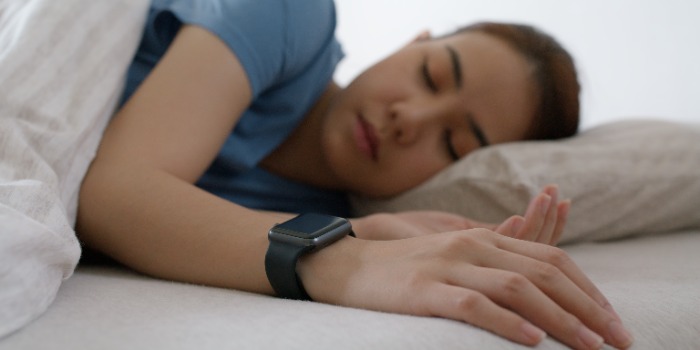
A sleep tracker or sleep monitor is a device that can record sleep. This could be a device that you wear such as a smartwatch, ring, or headband. These are often called ‘wearables’. Or it could be a device that is kept near you, such as under your mattress. Smartphones also have apps that can measure your sleep using your phone’s microphone.
There are different measurements that that these devices take while you sleep. Depending on the type of device, sleep trackers can measure:
- how much you move
- sounds such as snoring
- oxygen levels in your blood
- brain activity
- your heart rate
Smartphone trackers can probably only tell you a few sleep metrics such as how much time you spent asleep and if you snore. Whereas wearables can give a lot more information. This includes detecting sleep stages (awake, light sleep, deep sleep and REM). Sleep trackers may calculate a sleep score (out of 100) for you using the data it collects.
Sleep trackers may also give advice on your health and lifestyle to see if these help you get better sleep. They can also play soothing music.
Do sleep trackers really work?
Sleep trackers can collect a lot of data on your sleep. But studies have found that sleep trackers may overestimate sleep time. Certain brands may perform better than others. Try not to treat what sleep trackers tell you about your sleep as 100 per cent accurate, but more of an estimate.
You might find a sleep tracker helpful if you’re interested in seeing how you sleep. Trackers may provide personalised tips and advice that you might like to try to improve your sleep. If you’re having sleep problems, it’s best to see a GP as they can help you find the cause, as well as give you sleep advice and any needed treatment. Data from a sleep tracker may also be useful to share with your GP or other health professional.
What are the risks of using a sleep tracker?
Sleep trackers are mostly non-invasive, but you might find it uncomfortable to wear a device while you sleep. You could try using a device that you don’t have to wear, such as your smartphone. But smartphone sleep monitoring apps are more limited in what they can measure than wearables.
Using a tracker may cause you to worry about getting a good sleep score. This might make you stressed or anxious , which is not good for sleep.
Another thing to think about is the cost. Some health tracking devices can be very expensive. You might also need a subscription, and have to spend more to get additional features.
What is the best sleep tracker?
There are a lot of sleep trackers out there. The best one for you will depend on your needs and what you want from a sleep tracker.
Here are things to consider when looking for a sleep tracker.
- Reviews – seeing what other people say about their experience using a tracker can really help decide if a tracker is worth getting.
- What data the tracker collects - make sure you fully understand what the tracker is measuring.
- Battery life – see how long the battery lasts for and how regularly you need to charge it.
- Display – how you’re able to see the metrics, for example you might be able to see this on a smartwatch screen, or for other devices you need to check a separate app on your phone.
- The cost – this will depend on how much you’re willing to spend, and if you want to pay for a subscription.
Remember, if you are having sleep problems and it’s affecting your life, it’s best to speak to a GP.
Are you interested in learning more about your health? Discover more about our range of health assessments.
-
Sources Sources
- Why Do We Need Sleep? Sleep Foundation. sleepfoundation.org, updated July 2025
- Lee T, Cho Y, Cha KS, et al. Accuracy of 11 Wearable, Nearable, and Airable Consumer Sleep Trackers: Prospective Multicenter Validation Study. JMIR Mhealth Uhealth. 2023 Nov 2;11:e50983. doi: 10.2196/50983
- Mathunjwa BM, Kor RYJ, Ngarnkuekool W, et al. A Comprehensive Review of Home Sleep Monitoring Technologies: Smartphone Apps, Smartwatches, and Smart Mattresses. Sensors (Basel). 2025 Mar 12;25(6):1771. doi: 10.3390/s25061771
- Willoughby AR, Golkashani HA, Ghorbani S, et al. Performance of wearable sleep trackers during nocturnal sleep and periods of simulated real-world smartphone use. Sleep Health. 2024 Jun;10(3):356-368. doi: 10.1016/j.sleh.2024.02.007
- Best Sleep Trackers of 2026. Sleep Foundation. sleepfoundation.org, updated April 2026
About our health information
At Bupa we produce a wealth of free health information for you and your family. This is because we believe that trustworthy information is essential in helping you make better decisions about your health and wellbeing.
Our information has been awarded the PIF TICK for trustworthy health information.

More general health advice articles



Did you find our advice helpful?
We’d love to hear what you think. Our short survey takes just a few minutes to complete and helps us to keep improving our healthy lifestyle articles.
Legal disclaimer
This information was published by Bupa's Health Content Team and is based on reputable sources of medical evidence. It has been reviewed by appropriate medical or clinical professionals and deemed accurate on the date of review. Photos are only for illustrative purposes and do not reflect every presentation of a condition.
Any information about a treatment or procedure is generic, and does not necessarily describe that treatment or procedure as delivered by Bupa or its associated providers.
The information contained on this page and in any third party websites referred to on this page is not intended nor implied to be a substitute for professional medical advice nor is it intended to be for medical diagnosis or treatment. Third party websites are not owned or controlled by Bupa and any individual may be able to access and post messages on them. Bupa is not responsible for the content or availability of these third party websites. We do not accept advertising on this page.