

How do creative hobbies benefit your health?

When you think about what supports your wellbeing, it’s likely that you think of exercise and diet. But creative hobbies can also boost your mental and emotional health. Here, I explain how creativity can benefit your health and how to fit it into your routine.
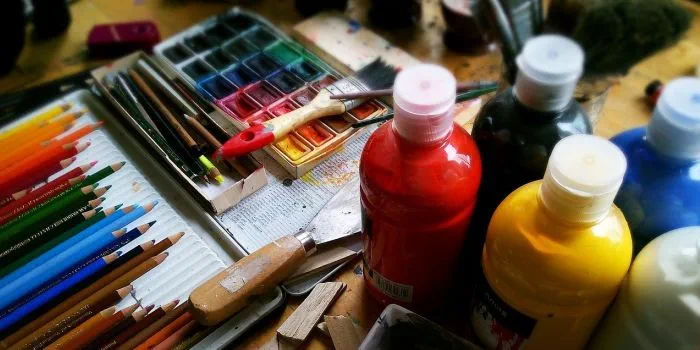
What are the health benefits of creativity?
Creative outlets can be fun and rewarding. They can also:
- reduce feelings of stress and loneliness
- improve your mood
- positively affect how your brain works
Creativity and imagination help children become resourceful. And this can be beneficial to adults, too. In fact, having hobbies has even been linked to healthier aging and greater happiness in later life.
Whether it’s drawing, singing, or dancing, having a creative outlet can have a positive effect on your mind. Here are some of the ways that creative activities can benefit you.
1. Creativity can get you into a state of flow
One of the ways that creativity benefits your wellbeing is by helping you reach a state of flow. This happens when you’re completely focused on a task, to the point where you think less about things that are worrying you.
Being this absorbed can be rewarding and enjoyable – especially because you’re more likely to get into a flow state if the task is challenging enough.
Bupa Lead Behavioural Insights Specialist, Sarah Griffiths, enjoys completing jigsaw puzzles for this reason. “I love how I can be completely absorbed for periods of time. It’s great if I’m feeling stressed to just take some time from thinking about other things. It could just be for half an hour or for longer. I like large and tricky puzzles, and I can also listen to podcasts at the same time.”
2. Creativity can reduce stress and improve mental health
A recent survey reports that over seven in ten feel that having a creative outlet helps them better process their emotions. Plus, several studies have shown that creative hobbies, such as art, writing and music, can reduce and even prevent stress.
You may find that, after a stressful day, enjoying a hobby can:
- help you de-stress
- give you an energy boost
- reduce feelings of anxiety and depression
- help you express or manage your emotions in a positive and productive way – especially when those feelings are difficult to put into words
3. Hobbies can help you socialise
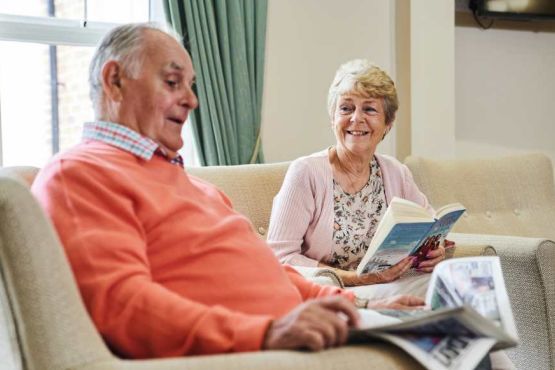
Hobbies don’t have to be done on your own – they can also be a way to socialise with others. If you enjoy reading, for example, you could join a book club; or if you like drawing or painting, you could join an art class. Group activities like these can be a great way to meet new people. And being socially connected also has a positive effect on your wellbeing.
4. Creativity affects brain function
Creative activities activate different areas of the brain. For example, research has shown that musicians have better connectivity between the left and right parts of their brains. This can help to improve cognitive function (the way your brain works). Simply listening to music can also stimulate your brain, and has been shown to improve cognitive function in people who have had a stroke.
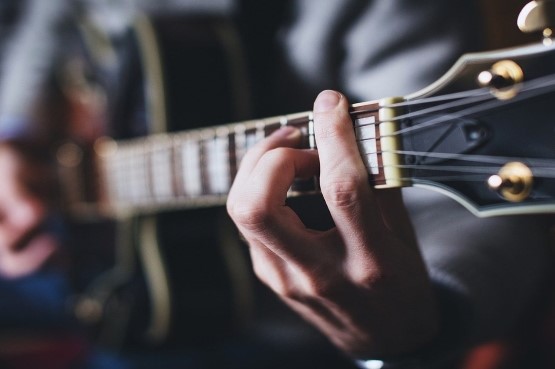
For Graham, a parent, playing a musical instrument also provides mindful relaxation. “I really enjoy playing the acoustic guitar. There’s something very relaxing and mindful about sitting down, playing different chords and finger-picking patterns and seeing where it takes me. I could happily sit there for hours doing this, if I had the time”
Fun ways to get creative
Creativity is good for your health, but finding time for it can be tricky. The key is to fit it into your routine in a way that works for you.
Sarah suggests you start small. “As with other habits, if you’re starting something new then it’s best to start small before trying anything more advanced or buying specialist equipment. You don’t want to feel pressured to spend time on a new hobby. So, see how you can fit it into your everyday life, and if you get enjoyment from it.”
If you’re stuck for ideas, here are some easy ways to get creative.
- Colour pencil drawing. Try a small drawing each day to build your observation and drawing skills over time. You don’t need much equipment, and you’ll end up with a collection of artwork to look back on. If you find you enjoy it, you could always try painting next.
- Photography. Taking a photo is very easy if you have a smartphone. It can also help you notice everyday details you might usually overlook.
- Write one short story a month. Many of us may not have written an imaginative story since being at school. A short story can be just a couple of pages long and start with a simple question you have. Finishing a story can also be very fulfilling. Or, if you have an idea for a longer story, jot it down and see where it takes you. Writing can help develop research and analytical skills, interest in other languages, and is creative too.
- Try knitting, crochet or sewing. The repetitive action of knitting, crochet and sewing can be relaxing, while still being creative. If you’re feeling adventurous, you could try more complex patterns as you get better with practice.
- Bake a cake. Baking is not only a creative outlet, but it can also be stress-relieving and fulfilling when you get to eat the end result! Or, even better, give your freshly baked creations to your loved ones.
- Start a journal. Simply writing your thoughts down on the page can be therapeutic, and it can be fun to look back on happy memories. You could include drawings, too. If you’re stuck about where to start, you could find some journal prompts online.
- Make a scrapbook or junk journal. Do you keep tickets from concerts or journeys you’ve gone on? Why not turn them into art and stick them in a scrapbook? You can get creative with the layout and the design, while keeping your mementos safe.
- Get green. Looking after plants and watching them flourish is a satisfying and relaxing hobby for many people. You don’t need to have a garden, either – indoor plants have similar benefits, and being around greenery is good for your mental health.
- Have a go at pottery. Get creative with clay, whether it’s using just your hands or a wheel. Why not try making a small figurine, a mug or a vase? You can try experimenting with different shapes, textures and colours too.
Kickstart healthy habits with confidence
Our health assessments help you understand your health and set meaningful goals. You’ll get a personalised action plan, plus 12 months of expert support to help you stay on track.
Co-author
Sharon Best, Mental Wellbeing Practitioner
Dr Sarah Griffiths, Bupa’s Lead Behavioural Insights Advisor.
-
Sources Sources
- Martin L, Oepen R, Bauer K et al. Creative Arts Interventions for Stress Management and Prevention-A Systematic Review. Behav Sci (Basel) 2018;8:28. doi:10.3390/bs8020028
- Beaty RE, Benedek M, Silvia PJ, Schacter DL. Creative Cognition and Brain Network Dynamics. Trends Cogn Sci 2016;20:87-95. doi:10.1016/j.tics.2015.10.004
- Galassi F, Merizzi A, D’Amen B, Santini S. Creativity and art therapies to promote healthy aging: A scoping review. Front Psychol 2022;13:906191. doi:10.3389/fpsyg.2022.906191
- Pauly T, Chu L, Zambrano E, Gerstorf D, Hoppmann CA. COVID-19, Time to Oneself, and Loneliness: Creativity as a Resource. J Gerontol B Psychol Sci Soc Sci 2022;77:e30-35. doi: 10.1093/geronb/gbab070
- Israel SM, Adams-Price CE, Bolstad CJ, Nadorff DK. Age and recognition for one’s creative hobby are associated with fewer depressive symptoms in middle-aged and older adults. Psychol Aesthet Creat Arts 2022;16:610-617. doi:10.1037/aca0000366
- Imagination and creativity. UK Government. gov.uk, last updated March 2026
- Mak HW, Noguchi T, Bone JK, et al. Hobby engagement and mental wellbeing among people aged 65 years and older in 16 countries. Nat Med. 2023;29(9):2233-2240. doi: 10.1038/s41591-023-02506-1
- Van der Linden D, Tops M, Bakker AB. The Neuroscience of the Flow State: Involvement of the Locus Coeruleus Norepinephrine System. Front Psychol 2021;12:645498. doi: 10.3389/fpsyg.2021.645498
- Effortless attention in everyday life: a systematic phenomenology. Effortless Attention: A New Perspective in the Cognitive Science of Attention and Action. Bruya B (ed). MIT Press, April 2010
- Research by Opinium. Bupa Express Your Health campaign, April 2026.
- Kaimal G, Ray K, Muniz J. Reduction of Cortisol Levels and Participants' Responses Following Art Making. Art Ther (Alex) 2016;33:74-80. doi:10.1080/07421656.2016.1166832
- Stuckey HL, Nobel J. The Connection Between Art, Healing, and Public Health: A Review of Current Literature. Am J Public Health 2010;100:254-263. doi:10.2105/AJPH.2008.156497
- Look after your thinking skills. Age UK. ageuk.org.uk, last updated July 2024
- Sun J, Chen Q, Zhang Q, et al. Training your brain to be more creative: brain functional and structural changes induced by divergent thinking training. Hum Brain Mapp 2016;37:3375-3387. doi:10.1002/hbm.23246
- Demarin V, Bedekovic MJ, Puretic MB, Pasic MB. Arts, brain and cognition. Psychiatr Danub 2016;28:343-348
- Kawasaki A, Hayashi N. Musical instrumental reading affects middle cerebral blood flow and cognitive function. Front Psychol 2022;13:966969. doi:10.3389/fphys.2022.966969
- Plants to help ease the mind. Thrive. thrive.org.uk, accessed April 2026
About our health information
At Bupa we produce a wealth of free health information for you and your family. This is because we believe that trustworthy information is essential in helping you make better decisions about your health and wellbeing.
Our information has been awarded the PIF TICK for trustworthy health information.
More general health advice articles



Did you find our advice helpful?
We’d love to hear what you think. Our short survey takes just a few minutes to complete and helps us to keep improving our healthy lifestyle articles.
Legal disclaimer
This information was published by Bupa's Health Content Team and is based on reputable sources of medical evidence. It has been reviewed by appropriate medical or clinical professionals and deemed accurate on the date of review. Photos are only for illustrative purposes and do not reflect every presentation of a condition.
Any information about a treatment or procedure is generic, and does not necessarily describe that treatment or procedure as delivered by Bupa or its associated providers.
The information contained on this page and in any third party websites referred to on this page is not intended nor implied to be a substitute for professional medical advice nor is it intended to be for medical diagnosis or treatment. Third party websites are not owned or controlled by Bupa and any individual may be able to access and post messages on them. Bupa is not responsible for the content or availability of these third party websites. We do not accept advertising on this page.