

Why does my body need carbohydrates?

Carbohydrates can be an important part of a healthy diet. They provide you with energy, as well as essential nutrients. But not all types of carbohydrates are good for you. Here, I’ll talk about what carbohydrates are, where they come from, and how much your body needs.

What are carbohydrates?
Carbohydrates are your body’s main source of energy. While fats and protein also provide energy, carbohydrates are the preferred type of energy source. This is because they’re quickly turned into sugar (glucose). This glucose is essential for your brain and nervous system. Your body also uses glucose for exercise and other functions.
Wholegrain, starchy carbohydrates are also an important source of essential nutrients and fibre.
What types of carbohydrates are there?
There are two main types of carbohydrates: complex carbohydrates and refined carbohydrates.
Complex carbohydrates include:
- wholegrain bread
- brown rice
- jumbo oats
- wholewheat cereals
- potatoes with the skin left on
Refined carbohydrates include:
- white bread and pasta
- biscuits and pastries
- sweets and cakes
Which types of carbohydrates are better for my health?
Complex carbohydrates provide your body with a steady source of energy. They release sugar into your blood more slowly than sugary foods and drinks, or refined carbohydrates like white bread. This can keep you feeling fuller for longer, helping to control your appetite and maintain a healthy weight.
The ‘free’ sugars added to processed foods and drinks – like biscuits, fizzy drinks, chocolate, and cake – are best consumed only occasionally. These foods and drinks can be high in calories, raise your blood sugar, and often lack other useful nutrients.
Free sugars are also naturally present in honey, syrups, and fruit juices, so it can be confusing to understand what’s helpful or not. What’s important is to be aware of these free sugars and try to reduce your sugar intake when you can.
Processed or refined starchy carbohydrates, such as white bread, pasta, and cereals are less healthy than wholegrain options. This is because when grains are processed, fibre and other valuable nutrients are removed to make them look whiter.
How many carbohydrates do I need?
Aim to make starchy foods – ideally wholegrain starchy carbohydrates – about a third of your diet. Include things like wholemeal bread, brown pasta, or brown rice in every meal, as well as some fruits and vegetables. In general, a portion of carbohydrate for one meal should be about the size of your fist. The exact amount you need differs from person to person. It depends on many things, including how active you are. As a minimum, adults should have 130g of carbohydrates per day.
Do all bodies react the same to carbohydrates?
The way carbohydrates affect your body can depend on if you have certain conditions. If you have diabetes, carbohydrate counting becomes very important. A registered dietitian can help you with this. While you must watch your intake of sugary foods, this doesn’t mean you have to completely cut out carbohydrates. There are healthier sources of carbohydrates you can include in your diet such as fruit, vegetables, and wholegrains.
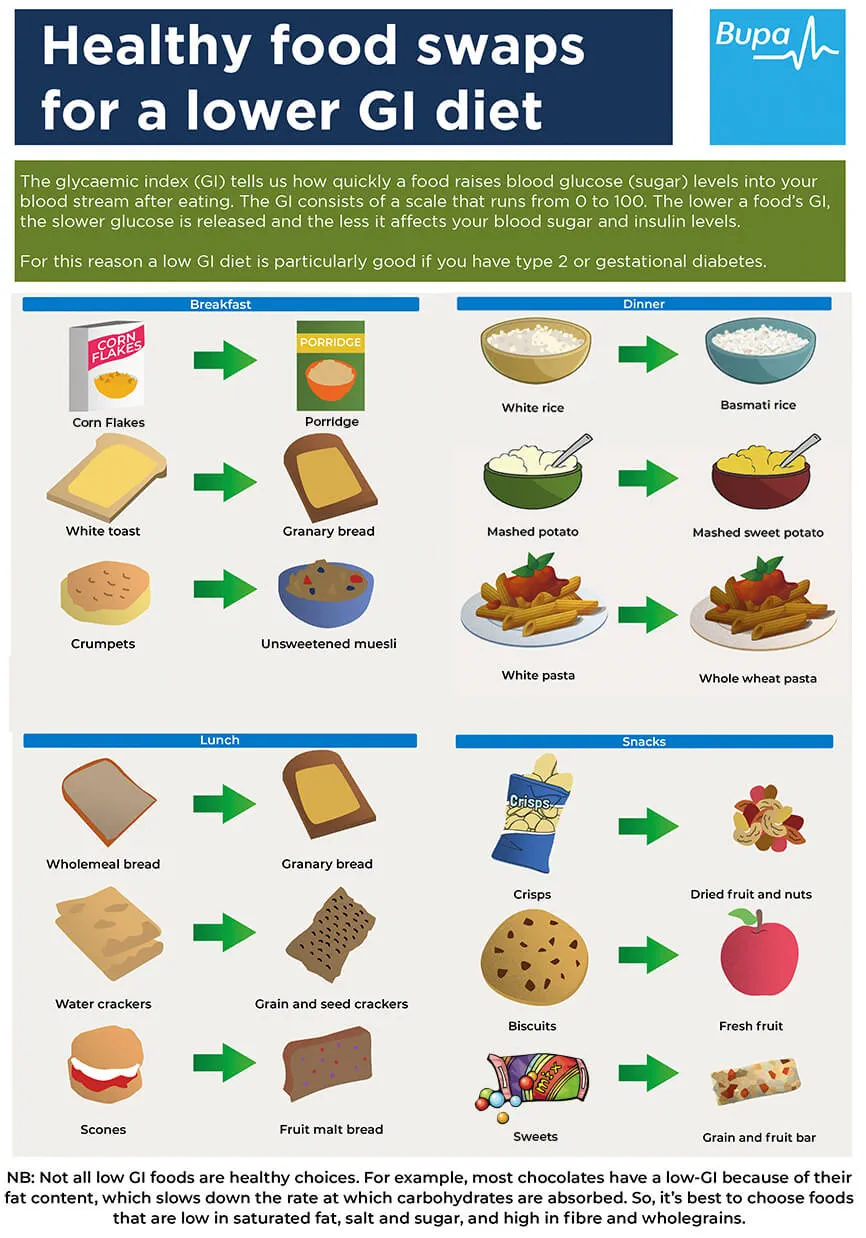
These are foods with a low glycaemic index (GI). GI is a measure of how quickly the carbohydrates in your food are digested and broken down into sugar molecules. Low-GI foods cause your blood sugar level to rise and fall slowly, so you feel fuller for longer.
See our infographic below of healthy food swaps for a lower GI diet.
Should I eat a low carbohydrate diet?
Some diet plans, such as the Keto diet and the Atkins diet, are based on reducing the amount of carbohydrates you eat. However, there’s no evidence that diets like this are any more effective than diets that focus on reducing your overall calorie intake. Diets like this can also be difficult to stick to, which can make it harder to maintain weight loss in the long-term. In addition, low-carbohydrate diets often don’t leave room for the healthy carbohydrates in fruit, vegetables, and wholegrains, which contain essential nutrients and fibre.
Carbohydrates do contain calories, but less than half the number found in fat. Of course, it’s important not to overeat any food group.
If you eat more carbohydrates than your body can burn off as energy, the excess will be converted to fat. But carbohydrates are an important part of a healthy diet. So instead of removing carbohydrates from your diet completely, focus on choosing the right kinds.
Build a better diet
Access tips, recipes and expert advice to re-frame how you think about food. Try it at your own pace and make changes you can stick to. Go to Wellbeing in the My Bupa app to start your plan.
-
Sources Sources
- Carbohydrates. The Association of UK Dietitians. bda.uk.com, reviewed September 2024
- Wholegrains. The Association of UK Dietitians. bda.uk.com, reviewed May 2025
- Starchy foods. British Nutrition Foundation. nutrition.org.uk, last reviewed October 2023
- Essential nutrients. Encyclopaedia Britannica. britannica.com, accessed December 2025
- Glycaemic Index (GI). The Association of UK Dietitians. bda.uk.com, last reviewed December 2025
- The Eatwell Guide. Public Health England. gov.uk, updated September 2018
- Carbohydrates and diabetes: what you need to know. Diabetes UK. diabetes.org.uk, accessed January 2026
- Diabetes - type 2. NICE Clinical Knowledge Summaries. cks.nice.org.uk, last revised July 2025
- Fields H, Ruddy B, et al. Are low-carbohydrate diets safe and effective? J Am Osteopath Assoc 2016; 116: 788-93. doi:10.7556/jaoa.2016.154
- Overweight, Obesity and Weight loss. British Nutrition Foundation. nutrition.org.uk, accessed December 2025
- Do carbs make you gain weight? British Heart Foundation. bhf.org.uk, published September 2024
About our health information
At Bupa we produce a wealth of free health information for you and your family. This is because we believe that trustworthy information is essential in helping you make better decisions about your health and wellbeing.
Our information has been awarded the PIF TICK for trustworthy health information.




Did you find our advice helpful?
We’d love to hear what you think. Our short survey takes just a few minutes to complete and helps us to keep improving our healthy lifestyle articles.
Legal disclaimer
This information was published by Bupa's Health Content Team and is based on reputable sources of medical evidence. It has been reviewed by appropriate medical or clinical professionals and deemed accurate on the date of review. Photos are only for illustrative purposes and do not reflect every presentation of a condition.
Any information about a treatment or procedure is generic, and does not necessarily describe that treatment or procedure as delivered by Bupa or its associated providers.
The information contained on this page and in any third party websites referred to on this page is not intended nor implied to be a substitute for professional medical advice nor is it intended to be for medical diagnosis or treatment. Third party websites are not owned or controlled by Bupa and any individual may be able to access and post messages on them. Bupa is not responsible for the content or availability of these third party websites. We do not accept advertising on this page.