

Caring for your teeth at university: A student’s guide

If you’re moving away from home for the first time, university life brings plenty of new experiences. You might be juggling early lectures with late nights in the library, making new friends or even learning to cook. With so much to think about, dental care might not make it onto your to-do list. But building healthy habits now can set you up for a lifetime of good oral health. Here, I’ll share practical dental care tips for students.

Why is it important to take care of your teeth?
Taking care of your teeth isn’t just about appearance. Neglecting your oral health can cause bad breath, stained teeth, tooth decay, and gum disease. These problems can affect your confidence, and you might need time off university for pain or treatment. Your mouth also affects your whole body – research shows that gum disease can raise your risk of conditions like heart disease and diabetes. It’s also been linked to changes in brain health that affect your memory and thinking skills over time.
How can you look after your teeth at university?
Here are four ways to look after your teeth while studying.
1. Register with a local dentist
If your university is far from home, and you spend most of your time there, register with a local dentist. You can keep going for regular check-ups and have someone to call if you have a dental emergency. Where you register is up to you. But if you’re not sure where to start, your university health centre can recommend a nearby practice.
2. Keep taking care of your teeth
Sticking to a routine while studying isn’t always easy. Your schedule can change every semester, and you might forget to brush your teeth if you get home late or you’re busy cramming for exams. But looking after your teeth can help prevent problems from developing. Aim to:
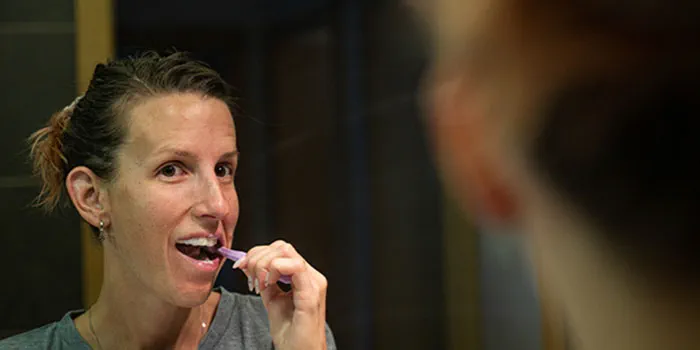
- brush your teeth twice a day, for two minutes – before bedtime and at one other time of day.
- clean between your teeth daily using floss, an interdental brush or water flosser.
- use a fluoride toothpaste that contains 1,350 to 1,500 parts per million (ppm) fluoride.
- replace your toothbrush every two to three months, or sooner if the bristles fray.
3. Watch what you eat and drink
Learning how to shop, cook, and eat well can be challenging – especially on a tight student budget. And you might be tempted by ready meals, takeaways, fast food, and snacks to keep you going. But a healthy diet can help you to learn, remember, solve problems, as well as protect your teeth.
Sugar
Whenever you eat or drink something sugary, bacteria that live in your mouth feed off the sugar and make acids. These acids then mix with saliva and food to create plaque – a sticky coating on your teeth. Without brushing, the acids in plaque strip away the minerals from the outer layer of your tooth (enamel), which can eventually lead to tooth decay.
Foods like cakes, biscuits, chocolate, sweets, cereal, alcohol, and fizzy drinks are often high in sugar. So, it’s important to keep these to mealtimes only, and avoid having them in between meals, to give your teeth a chance to recover from acid attacks.
Tip: Try swapping sugary snacks for healthier options like raw fruit and vegetables or unsalted nuts.
Fizzy drinks
Not only are fizzy drinks high in sugar, but they’re also acidic, so they attack your teeth in two ways. The sugar causes decay, while the acids can wear away your tooth enamel. And when your enamel gets thinner, your teeth become weaker and more sensitive.
Tip: Choose water or lower fat milk instead of fizzy drinks, or drink them through a straw to reduce contact with your teeth.
Alcohol
If you plan to drink alcohol during your time at university, be aware that alcohol is often acidic and high in sugar too. Drinking a lot of alcohol can also increase your risk of mouth cancer.
Tip: Try sticking to 14 units per week, spreading these out across the week, and having some alcohol-free days too. Fourteen units is around six pints of four per cent beer or six glasses of 13 per cent wine.
Energy drinks
You might start sipping on energy drinks when you have an early lecture or a deadline to hit. But these often contain high amounts of sugar and caffeine. While sugar can cause tooth decay, drinking too much caffeine can make you anxious and disturb your sleep.
Tip: Choose sugar-free versions where possible and limit your caffeine intake to 400mg per day. That’s around five cups of tea or four cups of instant coffee.
4. Avoid smoking and vaping
While university is full of new experiences, try not to make smoking or vaping one of them. You’re twice as likely to develop gum disease if you smoke. It can also stain your teeth and make your breath smell bad.
Smoking is also one of the biggest risk factors for mouth cancer. This includes chewing, sucking or sniffing smokeless tobacco products like chewing tobacco, paan and nasal snuff.
Vaping is thought to be less harmful for your health than smoking and a useful tool to help you quit smoking. However, experts don’t know what the long-term effects of vaping (also known as e-cigarettes) could have on your health yet. But they do expose your mouth to nicotine and other chemicals that could harm your health. So, if you don’t vape or smoke, it’s best not to start.
Do students get free dental care?
In England, you can get free NHS dental care if you’re:
- under 18
- under 19 and still in full-time education
But this doesn’t usually include cosmetic treatments, like teeth whitening, veneers or braces.
Once you turn 20, you’ll need to pay NHS charges unless you’re exempt, for example if you’re:
- pregnant or had a baby in the last 12 months
- on a low income
- receive certain benefits
How much students pay for dental treatment will depend on where you live and which treatment you need.
Some dental schools and hospitals also offer cheaper treatment, but you’ll be treated by a dental student. You can also pay to see a private dentist if you prefer.
Find a Bupa dentist near you
Choose from over 360 private and NHS dentists across the UK, and book your appointment online.
-
Sources Sources
- Azam T, Kitsaras G et al. The association between oral health and risk behaviours of university students. PLOS ONE 2025: 20(3): e0309183 doi.org/10.1371/journal.pone.0309183
- Gum disease. Oral Health Foundation. dentalhealth.org, accessed November 2025
- Paying for dental treatment in the UK. Oral Health Foundation. dentalhealth.org, accessed November 2025
- Chapter 8: Oral hygiene. Delivering better oral health: an evidence-based toolkit for prevention. Department of Health & Social Care. gov.uk, updated September 2025
- Caring for my teeth. Oral Health Foundation. dentalhealth.org, accessed November 2025
- Food and your brain. British Nutrition Foundation. nutrition.org.uk, accessed November 2025
- Diet and my teeth. Oral Health Foundation. dentalhealth.org, accessed November 2025
- Sugar. British Dietetic Association. bda.uk.com, published January 2022
- Dental erosion. Oral Health Foundation. dentalhealth.org, accessed November 2025
- Nutrition for students. British Nutrition Foundation. nutrition.org.uk, accessed November 2025
- Mouth cancer. Oral Health Foundation. dentalhealth.org, accessed November 2025
- Smoking, gum disease and tooth loss. Centers for Disease Control and Prevention. cdc.gov, last reviewed February 2025
- Smoking and oral health. Oral Health Foundation. dentalhealth.org, accessed November 2025
- Bad breath. Oral Health Foundation. dentalhealth.org, accessed November 2025
- Chapter 11: Smoking and tobacco use. Delivering better oral health: an evidence-based toolkit for prevention. Department of Health and Social Care. gov.uk, updated September 2025
- Tobacco: E-cigarettes. World Health Organization. who.int, published January 2024
- Dental treatment by undergraduate students. Dental Schools Council. dentalschoolscouncil.ac.uk, accessed November 2025
About our health information
At Bupa we produce a wealth of free health information for you and your family. This is because we believe that trustworthy information is essential in helping you make better decisions about your health and wellbeing.
Our information has been awarded the PIF TICK for trustworthy health information.

More dental health advice articles


Did you find our advice helpful?
We’d love to hear what you think. Our short survey takes just a few minutes to complete and helps us to keep improving our healthy lifestyle articles.
Legal disclaimer
This information was published by Bupa's Health Content Team and is based on reputable sources of medical evidence. It has been reviewed by appropriate medical or clinical professionals and deemed accurate on the date of review. Photos are only for illustrative purposes and do not reflect every presentation of a condition.
Any information about a treatment or procedure is generic, and does not necessarily describe that treatment or procedure as delivered by Bupa or its associated providers.
The information contained on this page and in any third party websites referred to on this page is not intended nor implied to be a substitute for professional medical advice nor is it intended to be for medical diagnosis or treatment. Third party websites are not owned or controlled by Bupa and any individual may be able to access and post messages on them. Bupa is not responsible for the content or availability of these third party websites. We do not accept advertising on this page.