





Sarcopenia: How good habits can help reverse muscle loss

Your health expert: Fran Vandell, Dementia Lead, Bupa Care Services
Publish date 15 September 2025.
Next review 15 September 2026.
Fran Vandelli explores recent online search interest in sarcopenia and steps to combat for body and mind.
Meaning of sarcopenia

Sarcopenia is a disease that affects your muscle mass and strength.
It's most common amongst older people. As you get older, and especially once you reach 60, it's normal to lose some muscle density.
However, for those with sarcopenia, muscle loss happens more quickly. Losing your muscle mass can affect your independence and quality of life.
What the search engines are saying about sarcopenia
Google search volume data from May 2021 to April 2025 show searches around muscle loss and sarcopenia have seen significant growth. This suggests that more people are becoming aware of the condition, and are looking for ways to slow its effects.
The data shows:
Sarcopenia
Searches doubled.
Losing muscle mass with age
Searches doubled.
Meaning of sarcopenia
Searches tripled.
Sarcopenia treatment
Searches quadrupled
Causes of sarcopenia
Your muscle cells change as you age. As early as your 30s, muscle cells can start getting smaller.
Muscle cell changes happen because your body becomes less efficient in producing proteins, compared to when you re younger. As a result, muscle mass starts to drop.
Some people experience sarcopenia more than others, despite being the same age. It's thought that what you eat, how active you are, hormone levels and chronic diseases may contribute towards the rate you lose your muscle loss.
Muscle loss symptoms
Symptoms of sarcopenia include:
- Muscle weakness
- Difficulty walking as quickly
- Reduced stamina, e.g. it s harder to climb the stairs without stopping
- You're more prone to poor balance and falls
- Noticing visible changes to your appearance, like muscle wastage on your legs, buttocks or arms
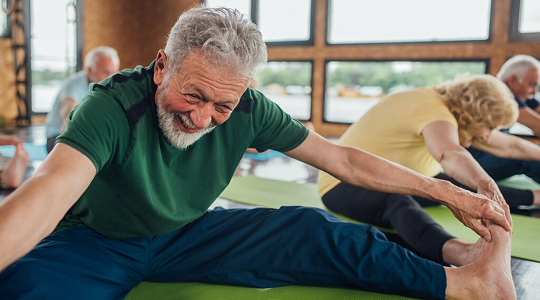
Sarcopenia treatment
Though muscle loss is common in older age, it's possible to make lifestyle changes to help reverse it and improve your quality of life.
Even if you're not currently physically active, slowly introducing more movement into your days can help develop muscles, and rebuild any you've lost.
Exercise also helps improve your bone density, posture and stamina.
Sarcopenia and exercise
If you have sarcopenia, incorporating more exercise into your life is always a good idea, but you don't have to start running marathons.
Like all active adults, you should be aiming for at least 150 minutes of exercise every week. Build this up slowly if you're not used to exercise, so your body has time to get used to the change this also helps prevent muscle strain and injuries.

If you spend lots of time in a chair or in bed, balloon based games, like volleyball or passing it to keep it in the air, can be an enjoyable way to introduce movement.

Once you ve grown your confidence, follow resistance training for older adults to reverse muscle loss and improve your strength, aiming for two sessions a week.
Climbing the stairs, weightlifting, squats and sit-ups all count towards resistance training, as does gardening.
Sarcopenia diet
What you eat can help keep you at a healthy weight, with strong muscles. If you have sarcopenia, along with exercise, regularly eating protein and calcium rich foods is key to help build and maintain muscle mass.
Aim to eat between 20 and 40 grams of protein in each of your meals and incorporate calcium-rich foods regularly.
Good sources of protein for each meal
- One pint of cow’s milk or soya milk
- Between 200 and 400 grams of Greek yoghurt. You can check the label to see protein values
- One 400 gram tin of baked beans
- Three medium eggs
- Palm-sized portions of chicken, meat or fish (around 100 grams)
- Around 300 grams of other beans and pulses, like lentils, chickpeas or kidney beans
Good sources of calcium
- Cow’s milk. Plant-based milk may be fortified with calcium too, but you’ll need to check the label to be sure
- Cheese and other dairy products
- Green, leafy vegetables

Vitamin D helps you make the most of the calcium you eat. You should also make sure to safely enjoy the sun in warmer months to absorb vitamin D through your skin. Then, when it gets to the darker seasons, take a daily 10 micrograms (µg) vitamin D supplement to help keep your levels topped up.
How to help someone with sarcopenia
Fran Vandelli, says:
“I know the importance physical activity can bring to care home residents, and the barriers they may face before being able to become more active.
“Staying active throughout your whole life is a huge part of keeping you physically well and maintaining independence when you’re older.
“If you spend long periods of time sat or lying down, it can lead to pain and discomfort in your body. When inactivity becomes part of your routine, it can also have a negative effect on your mood, and make it harder to motivate yourself to change your routine. You might hear this being referred to as ‘deconditioning’.
“Along with negative impact on mood, inactivity may suppress appetite. Eating and moving well has such a big impact on your overall wellbeing, from encouraging better quality sleep to embracing future active days.
“We encourage all our residents to get involved in activities where possible. Not only do these activities help promote muscle movement and build strength, but they’re often also a great way for our residents to bond.
“We also find that doing things together socially encourages our residents to motivate and support one another. Setting, achieving and celebrating small goals, one at a time, also works as its own great form of motivation.”
If you've been inactive for a while, or you re helping to care for someone in that position, it may be difficult to know where to start. However, these simple steps can help shake up routine and naturally build activities that form sustainable habits:

Offer support
Support your loved one to do as much as they can for themselves. Even if they find a task takes longer to do on their own, the practice and feelings of achievement will boost their self-esteem and muscles.

Have patience
Remember that it takes patience and support to help them rebuild both their muscles and confidence.

Things can take time
It takes twice as long to recover strength, mobility and skills. Losing the ability to move quickly and independently can take its toll on self-esteem. Those with sarcopenia may benefit from some extra motivation and encouragement to get up and ready.
