

Seborrhoeic dermatitis
Seborrhoeic dermatitis causes a red, flaky and itchy rash on your skin. It affects areas of your skin that tend to be greasier, such as your face, scalp and chest. It’s also known as seborrhoeic eczema, and cradle cap in babies.
About seborrhoeic dermatitis
Seborrhoeic dermatitis causes inflammation in areas of your skin that have a lot of sebaceous glands. These glands make an oily fluid called sebum, which keeps your skin supple. Areas of skin where you have lots of sebaceous glands include your face, scalp and chest. Seborrhoeic dermatitis also tends to affect areas of skin where there are skin folds that tend to stay moist. These include your armpits, under your breasts and your groin.
Seborrhoeic dermatitis affects up to 5 in every 100 adults. Around half of affected adults have dandruff, which is a mild, non-inflammatory form of seborrhoeic dermatitis that affects your scalp.
It’s very common for babies to get a short-lived, mild form of seborrhoeic dermatitis. This mainly affects their scalp, and is known as cradle cap. Otherwise, you can develop seborrhoeic dermatitis at any age from puberty onwards. This is because your sebaceous glands have become active. Men are more likely to get seborrhoeic dermatitis than women.
Causes of seborrhoeic dermatitis
It’s not clear why some people get seborrhoeic dermatitis. But it's thought it could be a reaction to a yeast called Malassezia, which lives on your skin. If you have seborrhoeic dermatitis, you may have more of this yeast growing on your skin or you may be more sensitive to it.
Most people who get seborrhoeic dermatitis are otherwise healthy. But it can sometimes be associated with other conditions. These include:
- conditions that affect your nervous system – for example, Parkinson's disease or stroke
- a weakened immune system – for example, due to human immunodeficiency virus (HIV) or taking certain medicines
- some genetic disorders – for example, Down syndrome
Your symptoms may get worse when you’re tired, stressed or feeling generally unwell. You may also notice that your symptoms are worse when it's cold, and better in warmer weather. HIV can make symptoms more severe and harder to treat.
It’s possible that diet may play a part for some people with seborrhoeic dermatitis. But the evidence isn’t strong enough to say if any particular foods trigger seborrhoeic dermatitis.
Seborrhoeic dermatitis isn’t contagious, so you can’t catch it or pass it on to another person.
Symptoms of seborrhoeic dermatitis
Seborrhoeic dermatitis causes red, flaky or scaly patches on your skin which may feel itchy and sore. On black or brown skin, the affected areas may look darker or lighter than the surrounding skin.
Symptoms in teenagers and adults
Seborrhoeic dermatitis causes red, flaky or scaly patches on your skin which may feel itchy and sore. On black or brown skin, the affected areas may look darker or lighter than the surrounding skin. Areas it often affects and the symptoms it causes include the following.
- Your scalp – symptoms range from mild, flaky skin (dandruff) to a more severe, scalier, itchy rash, which may weep or bleed if you scratch it.
- Your face – especially between your eyebrows, on your cheeks and in the folds at the sides of your nose. Your eyelids may be affected and become red, swollen and flaky. This is known as blepharitis.
- Your ears – the skin inside your ear may become inflamed, as well as your outer ear and the skin behind your ear.
- Your upper chest and your back between your shoulder blades – these areas may have round, pink or red patches with mild scaling.
- Skin folds – for example, your armpits, under your breasts and your groin. Your skin here might appear pink, shiny and cracked.
As an adult, seborrhoeic dermatitis is something that you’ll have for life. But your symptoms may come and go over time.
You can often deal with mild symptoms such as dandruff by yourself – ask a pharmacist for advice. If your symptoms are severe or cover a lot of your skin, contact your GP.
Symptoms in babies
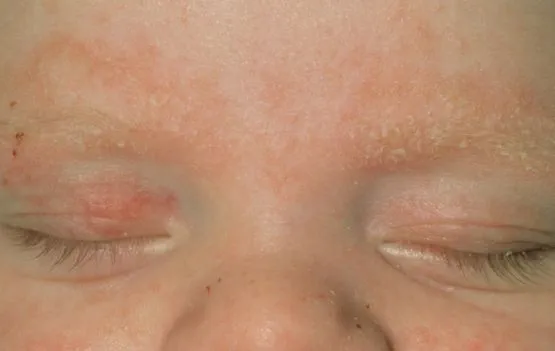
Babies often get a short-lived form of seborrhoeic dermatitis on their scalp, known as cradle cap. This causes greasy, yellow-brown, scaly patches on their scalp. Seborrhoeic dermatitis can sometimes also affect other parts of your baby’s body, including:
- their face
- behind their ears
- in skin folds
- their nappy area
In these areas, the affected skin usually has drier scales than those on their scalp. Any itching in babies is usually mild and is unlikely to bother your baby.
Cradle cap usually gets better by about three months of age, but it can take up to a year. If your baby has cradle cap, you won't normally need to see a doctor for a formal diagnosis or treatment. Your health visitor may advise how to deal with it using over-the-counter products. If it doesn’t improve or seems to be causing distress to your baby, contact your GP.
Get advice and treatment for skin issues.
Talk to a Bupa dermatologist (no referral needed) for advice about skin conditions and see our range of skin treatments available.
Diagnosis of seborrhoeic dermatitis
Your GP will usually diagnose seborrhoeic dermatitis just by looking at the affected areas of skin. They’ll also ask some questions about your symptoms and medical history. Seborrhoeic dermatitis can look similar to a number of other skin conditions, especially psoriasis. Sometimes, the two conditions can overlap.
If your GP isn’t sure if your symptoms are due to seborrhoeic dermatitis, they may refer you to a dermatologist. A dermatologist is a doctor who specialises in identifying and treating skin conditions. They may also refer you if your symptoms are very severe or cover large areas of your body.
If you have severe symptoms of seborrhoeic dermatitis, your doctor may recommend you have an HIV test. This is because severe seborrhoeic dermatitis can be a sign of having HIV, especially if it has come on suddenly.
Self-help for seborrhoeic dermatitis
There are things you can do to help yourself if you have seborrhoeic dermatitis.
Try to keep areas of skin affected by seborrhoeic dermatitis clean but don’t use soap or shaving cream if these irritate your skin. Use an emollient (moisturising) soap substitute instead. And use a light moisturiser after you wash. Ask a pharmacist if you need more advice.
There’s some research that suggests if you eat fruit, it may help to reduce flares but more evidence is needed to know for sure.
Your symptoms may get worse when you’re tired or stressed. Try to do things to help you relax, and avoid stress when you can. And try not to scratch your skin too much as this may break the skin and cause an infection.
Cradle cap
If your baby has seborrhoeic dermatitis on their scalp (cradle cap), try the following steps.
If your baby is affected in other areas, you may need to bathe them at least once a day using an emollient soap substitute. If it’s their nappy area that’s affected, make sure you change their nappy often. Use zinc and castor oil or white soft paraffin ointments on their skin.
Seborrhoeic dermatitis treatment
There's no cure for seborrhoeic dermatitis, but treatment can help to keep your symptoms under control. You may need to keep using seborrhoeic dermatitis treatments to control your symptoms over the long term. Or sometimes, you may only need them occasionally to help with flare-ups. Be aware that your symptoms are likely to come back when you stop using the treatment.
Your GP or dermatologist may prescribe seborrhoeic dermatitis treatments. But you can often buy them over the counter at a pharmacy or from a supermarket.
Scalp seborrhoeic dermatitis
If you have scalp seborrhoeic dermatitis, your pharmacist or GP will probably recommend that you try one of the following seborrhoeic dermatitis treatments.
- Medicated anti-dandruff shampoos. These contain ingredients such as ketoconazole, selenium, coal tar or zinc pyrithione. You leave the shampoo on for 5 minutes before you rinse it off. Sometimes you may need to use a descaling preparation, like coconut oil or salicylic acid, first.
- Corticosteroid (steroid) gels or lotions. You may need these if you have severe inflammation, itching and flaking. Only use gels or lotions for short periods (two weeks) unless you have specific advice from your GP. This is because they can cause side-effects like thinning of your skin.
If your seborrhoeic dermatitis keeps coming back, your GP may recommend that you carry on using an antifungal shampoo once every week or once every two weeks.
Cradle cap
If your baby has cradle cap, see our section on self-help for tips on how to treat it yourself. Your GP may prescribe an antifungal seborrhoeic dermatitis cream or steroid cream if your baby has cradle cap that doesn't clear up by itself.
Seborrhoeic dermatitis on your face and body
Your GP may prescribe the following seborrhoeic dermatitis treatments for your face or body.
- An antifungal cream that contains ketoconazole or another medicine. Apply this once or twice a day for at least four weeks to get your symptoms under control.
- An antifungal shampoo to use as a body wash.
- Medicated eardrops, if you have seborrhoeic dermatitis inside your ears.
- A steroid cream. You may be prescribed this together with an antifungal agent to reduce inflammation. Only use steroid creams for up to two weeks because they can cause side-effects like thinning of your skin.
- Topical calcineurin inhibitors. These include tacrolimus ointment and pimecrolimus cream. Your doctor may prescribe these instead of steroids if you need long-term treatment for inflammation.
Severe seborrhoeic dermatitis
Your GP may refer you to a dermatologist if your seborrhoeic dermatitis:
- is severe
- covers many areas of your body
- doesn’t respond to normal treatments
Your dermatologist may prescribe antifungal tablets if your rash is very severe or widespread. But this is rare.
Seborrhoeic dermatitis is one type of eczema. Eczema, also known as dermatitis, includes a number of skin conditions that cause inflammation and itchy skin.
Doctors aren’t sure why people get seborrhoeic dermatitis but it's thought to be fungal. It may be a reaction to a yeast called Malassezia, which is found on your skin. People with seborrhoeic dermatitis seem to have more of this yeast or are more sensitive to it.
For more details, see our section on causes of seborrheic dermatitis.
Seborrhoeic dermatitis is thought to be triggered by a reaction to yeast. Things that can make your symptoms worse include being tired, stressed or unwell. Cold weather can also make symptoms worse.
You can read more on this in our section on causes of seborrheic dermatitis.
You can’t completely get rid of seborrhoeic dermatitis – in adults, it’s a disease that you’ll have for life. But symptoms can come and go over time. And there are treatments to keep symptoms under control when you need it.
To find out how to manage your symptoms, see our section on treatment.
Psoriasis
Psoriasis is a lifelong skin condition that causes raised patches of inflamed skin. It affects people differently and can come and go over time.
Does stress cause skin problems?
Did you know that stress and skin problems such as itching or rashes can be linked?
Other helpful websites
Discover other helpful health information websites.
Did our Seborrhoeic dermatitis information help you?
We’d love to hear what you think. Our short survey takes just a few minutes to complete and helps us to keep improving our health information.
The health information on this page is intended for informational purposes only. We do not endorse any commercial products, or include Bupa's fees for treatments and/or services. For more information about prices visit: www.bupa.co.uk/health/payg
This information was published by Bupa's Health Content Team and is based on reputable sources of medical evidence. It has been reviewed by appropriate medical or clinical professionals and deemed accurate on the date of review. Photos are only for illustrative purposes and do not reflect every presentation of a condition.
Any information about a treatment or procedure is generic, and does not necessarily describe that treatment or procedure as delivered by Bupa or its associated providers.
The information contained on this page and in any third party websites referred to on this page is not intended nor implied to be a substitute for professional medical advice nor is it intended to be for medical diagnosis or treatment. Third party websites are not owned or controlled by Bupa and any individual may be able to access and post messages on them. Bupa is not responsible for the content or availability of these third party websites. We do not accept advertising on this page.
- Seborrheic dermatitis. Summary. BMJ Best Practice. bestpractice.bmj.com, last reviewed 28 March 2025
- Seborrhoeic dermatitis. NICE Clinical Knowledge Summaries. cks.nice.org.uk, last revised November 2024
- Eczema. NICE British National Formulary for Children. bnfc.nice.org.uk, last updated 10 April 2025
- Sebaceous gland. Encyclopaedia Britannica. www.britannica.com, last updated 2 April 2025
- Seborrhoeic dermatitis. British Association of Dermatologists. www.bad.org.uk, published January 2023
- Tucker D, Masood S. Seborrheic dermatitis. StatPearls Publishing. www.ncbi.nlm.nih.gov, last updated 1 March 2024
- Seborrhoeic dermatitis. Patient. patient.info, last updated 14 March 2022
- Woolhiser E, Keime N, Patel A, et al. Nutrition, obesity, and seborrheic dermatitis: Systematic review. JMIR Dermatol 2024; 7:e50143. doi: 10.2196/50143
- Seborrhoeic dermatitis & cradle cap in infants. National Eczema Society. eczema.org, accessed 2 May 2025
- Seborrhoeic eczema. National Eczema Association. nationaleczema.org, accessed 2 May 2025

 Member help and support