

Mental health at work
When the pressure of work adds up, we can help you face it. Find out how to prevent and manage work-related stress.

Let’s face workplace mental health
74% of employees suffer from workplace stress*. Left unmanaged, it can leave you feeling burnt out or worse. We can help you understand, manage and avoid it at work.

10 tips for managing stress effectively
Our top tips for reducing the symptoms of stress and managing them in a healthier way.

What is burnout and can I do anything about it?
Burnout can make you feel physically and emotionally exhausted. Here’s what you can do.

How do I manage anxiety at work?
Steps on how to manage anxiety in the workplace and what to do if it’s affecting your work.
Stress vs burnout
Watch in 3 mins
Understand the difference between stress and burnout, so you know exactly what you’re experiencing and how to address it.
We often hear the words stress and burnout used as if they're interchangeable, but they're not the same.
Stress is typically short term, and it's the body's immediate reaction to a current situation or challenge.
For example, a looming deadline at work or a family issue that's been playing on your mind.
And this can cause physical symptoms such as headaches or stomach problems, and mental health symptoms, such as feeling overwhelmed and struggling to concentrate or make decisions.
This, in turn, can lead to behavioural changes in your sleeping patterns and eating habits, or becoming more irritable with others.
The stress is usually temporary and it tends to pass once that pressure you're facing has lifted.
With exercise, relaxation techniques, and social connection, all being useful tools for managing it in the meantime.
Burnout, on the other hand, is what happens when stress is left unchecked.
It's a longer term state of emotional, physical, and mental exhaustion that's often caused by prolonged and excessive stress, and it builds slowly over time, and it can manifest with physical symptoms such as persistent fatigue or disturbed sleep, and also mental health symptoms such as emotional exhaustion and brain fog.
And this can lead to behavioural changes like reduced productivity, becoming detached and isolated, and seeking escapism through negative coping strategies such as food or alcohol.
And it can take longer to recover from as well, with lifestyle changes required such as disconnecting from work, prioritising rest, and setting stricter boundaries.
It's important to remember that neither is a sign of failure or an inability to cope.
The natural, biological and physiological response is actually designed to help you recognise when you're overstretched or running on empty, and that's why it's crucial to spot the signs early and take proactive steps to redress the balance and restore your overall well-being as quickly as possible.
The stress response cycle
Watch in 2 mins
What happens when you’re stressed and why what you’re feeling may be your body’s natural response.
How to get support
Let’s face mental health together: a guide to Bupa support
Watch in 3 mins
Find out how to access support through the My Bupa App. Our Mental Health Clinical Lead, Rhiannon Blackley, talks you through how to book digital appointments and what to expect when you do.
Protecting your mental wellbeing at work
Box breathing techniques
Watch in 2 mins
Bupa CBT therapist Bianca Clarke shows how the box breathing technique can help when you’re anxious, stressed or overwhelmed.
Everyday mindfulness
Watch in 3 mins
Joshua Fletcher shares mindfulness techniques you can bring into your everyday routine to help manage anxiety.
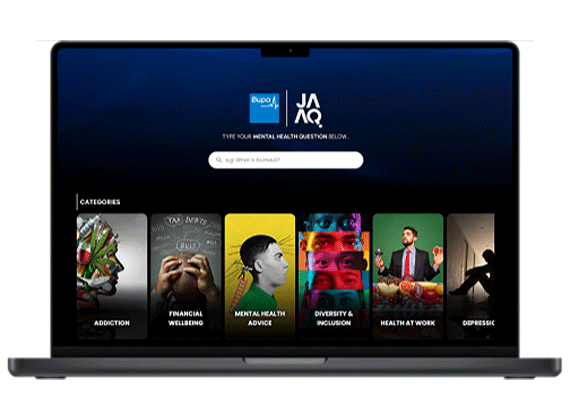
JAAQ at Work
JAAQ at Work provides expert answers to your questions on the most important mental health topics.
Support in the workplace
Mental health at work
Resources for coping with the everyday pressures of work-related stress, and what to do if you need help.
Support for managers
Practical tips to help managers support themselves and those they are responsible for.
We’re here to help when you need it
We offer both face-to-face and remote therapies at select Bupa centres across the UK.

Digital appointments
Speaking to a GP or mental health specialist shouldn’t be difficult. We offer flexible digital appointments to suit your schedule, whatever you’re facing.

Talking therapies
Book counselling, cognitive behavioural therapy (CBT) or clinical psychology. All either face-to-face or digitally.

Blua Wellbeing
Access clinically-led mental health and wellbeing content to help you build healthier, happier habits. Available in the My Bupa app.
*Bupa research facilitated, by Stick & Twist (2026).
 Member help and support