





Neurodiversity

Learning about neurodiversity
Neurodiversity is a term used to describe differences in the way people process information and view the world. These differences are natural, they just mean that neurodivergent people’s brains work in other ways.
Read more to find out more about neurodiversity and why it’s important to recognise these differences.
Common neurodiversity conditions explained

ADHD
Attention deficit hyperactivity disorder (ADHD) is a neurodevelopmental condition.

Dyspraxia
Dyspraxia is a condition that affects the way the brain communicates with the body to coordinate movements.

Dyslexia
Dyslexia is a life-long learning difference that can cause problems with reading, writing, and spelling.
Explaining autistic spectrum disorder (ASD)
David Mushati, Chief Clinical Officer at Melios, shares information about autism. He explains what autism is, the key signs in adults, common misconceptions and more.
Transcript
Who are you?
My name is Dr. David Mutti.
I'm the Chief Clinical Officer for LIOs.
I've spent the last 24 years working in healthcare,
including a significant amount of time working for the NHS.
I love what I do. I'm a consultant clinical psychologist.
I'm passionate about neuropsychology
and neurodevelopmental conditions,
and I have dedicated my life
to understanding some of the conditions
and helping people along the way,
which has been an immense privilege.
What is autism?
So autism is a way that people experience the world.
It's a way that they communicate and connect with others
and how they process their environment.
Think of it as a way of understanding
and processing your environment.
People with autism have different strengths and challenges,
and it's called a spectrum generally
because they are different within their presentations.
Are there different types of autism?
Autism used to be categorised into different types,
but now it's better understood as a spectrum,
and that means that while some people may share traits,
each person has their own unique combination of presentation
or traits and ways of experiencing the world.
What causes autism?
Autism is a neurodevelopmental disorder, so it's not
so much understood what causes it,
but what we know is that it is genetic
and it is a developmental disorder, which means
that it starts genetically and as an embryo
and proceeds throughout the person's life.
Can autism be cured and can autism go away?
That's an interesting question
because it's not so much that autism needs
to be cured or eradicated
or go away, as you've put it, it's much more that
people who experience difficulties due
to their understanding of the world
or the way that they process it, how they connect
with other people or process their environment
needs adaptation in order to help them to cope better
with those difficulties.
Otherwise, as a genetic
or neural condition, it's a part of who you are and
therefore it does not necessarily need curing.
Does autism run in families?
Yes, autism can run in families.
It has a genetic link.
However, there's no strict pattern that autism follows
in its genetic expression, and
therefore people who have autism
show different presentations at each point.
Can you develop autism as an adult?
No, you cannot develop autism as an adult, and that is
because it's genetic, so it is something
that you are born with.
However, it is not uncommon that
as young people transition into adulthood
and more popularly into secondary school, for instance,
they start to experience difficulties in their lives
that are later discovered or understood to be autism.
What is masking?
Masking is when a person with autism tries
to hide their traits or mask them.
They do this often by trying to mimic other people.
It can be quite exhausting.
The person's left feeling inauthentic.
However, it is common in people with autism
as they try and navigate social settings.
What is the difference between autism and Asperger's disorder?
Asperger's disorder used to be understood as autism,
but with fewer language delays.
Now it's considered as a part of autism
and autism, regardless of how mild
or pronounced it is, it's understood as one single
spectrum condition.
What are the key signs of autism in adults?
The key signs for autism in adults is
that a person might have some difficulty
with social interactions.
They may struggle with some sensory sensitivities
or have a strong need for routine.
It is often overlooked
because some adults adapt to the environment really well
or mask really well,
but it becomes very difficult to see
autism traits
and also sometimes an explanation to the adult's.
Presentation, for instance, might be put down
to personality quirks.
What impact can a late diagnosis of autism impact someone?
A late diagnosis of autism is very important to have
because what we tend to find is up until
that person is diagnosed, they
are experiencing difficulties within themselves.
So, for example, social interaction difficulties.
So this might be how they relate
to other people within the workplace or at home
or in their closer relationships.
And they might have a strong need for routine
and struggle with change
or particular sensory sensitivities that were
previously unexplained.
And these traits, these autism traits
express themselves in a way
that a person might end up internalising the difficulties
that they're having and exhibit mental health
conditions such as they might feel low in mood,
they might have social anxiety, for example.
So it's important to get a diagnosis
so the adult can have a better understanding of
who they are, and they can educate other people about
who they are and maybe
learn ways in which the environment can be adopted
to suit their needs
and presentation, which often will improve
the mental health presentations
and also the confidence in the adult in.
What are typical struggles faced in daily life by people with autism?
People with autism face many different struggles.
It's important to remember
that these differences are experienced very differently
by different people,
and typical difficulties that we come across are
difficulties in social interactions and relationships.
So psychosocial problems are primarily what
motivates adults to come and seek a diagnosis.
Some adults have a strong need for routine
and sensory sensitivities that may express themselves
as particularly challenging as they try
and navigate their social lives.
What are typical misconceptions about adults with autism?
There are many different types of
misconceptions about adults with autism.
The most prevalent ones, for instance, are
that autism is a childhood condition.
This is not true. Autism is a lifelong condition.
It's genetic. The second one is that
autistic people do not experience emotions.
Again, this is not true.
They experience emotions differently
and sometimes also express emotions very differently.
Another example that I can think of, a typical misconception
that I can think of is that
people with autism do not seek social relationships,
and that is not true.
Again, they do
and find enjoyment in social relationships.
I think the best way to think about this really is that
you need to know the person.
It's important to try and connect to the person
and understand who they are as an individual,
because what you tend to find is people are different,
behave differently despite whether they have autism or not,
and bringing your own misconceptions to that relationship
is unhelpful.
What are some effective coping strategies for autism?
So there's plenty of effective coping strategies
with autism, but the most effective could be sensory aids.
Connecting with supportive communities
could be very, very helpful.
Having a structured routine could also be helpful,
and therapy can also be helpful in order to help
with challenges that you may be experiencing,
but also to build on your existing strengths.
What are the benefits of receiving an autism diagnosis as an adult?
There's plenty of benefits of receiving a diagnosis
of autism as an adult.
I think most importantly, it brings a sense of validation
and it for some, explains some
of the challenges that they would have been experiencing
in their lives in the past
and allows the person to start looking forward.
It empowers them to adopt their environment in a way
that is helpful to them,
and also they can become an advocate for themselves
and help people to understand who they are.
What support services are available?
There's plenty of support services available
to help adults manage daily challenges.
It mostly depends on the extent
to which you are experiencing your difficulties
or the challenges, and at a lower end
you can get commuter services.
There's a lot of evidence to suggest that
peer support within
or between people who have been diagnosed with autism
is particularly helpful.
You can, on the higher end
approach your general practitioner, for instance,
and get treatment for
or referral for treatment
for particularly persistent mental health difficulties
or severe mental health difficulties within the workplace.
You can get occupational therapy,
you can approach your employer
to see if they have an insurance scheme to so
that you can access services that you might need to help you
with the particular difficulties that you're experiencing.
What is peer support?
Peer support is particularly important in supporting
people with autism and it's best understood as a person
with autism approaching a structured
or semi-structured group where other people have autism.
This could be on online forum,
it could be in a face-to-face group,
which are particularly helpful
and it brings a sense of belonging to the person.
It normalises the challenges
that the woulda big experiencing.
It helps foster a better understanding of the variation
and the differences of people with autism in particular,
the diverse set of strengths
and personalities that they come with.
So there's a lot of benefit to be held from peer support.
What is the role of occupational therapy in supporting someone with autism?
Occupational therapy is a professional
and they are particularly trained in helping an individual
with autism to cope with their activities of daily living,
and this could be helping them strategize their time better
and utilise that time better.
It could be helping them with the sensory difficulties
that they're experiencing.
Occupational therapy is particularly helpful in helping
that person adopt
and cope with the environment in a much more efficient
and supportive way to them.
What role does sensory processing play in autism?
Sensory processes play a big part in autism.
People with autism experience different sensory challenges,
including sound, noise,
touch, and light sensitivities.
And in public, particularly around the sound sensitivities,
it's often common to wear
noise cancelling headphones.
A lot of adults that we worked
with when accident the community would,
or commuting for instance, if you imagine the noise
that you might find during rush hour traffic
or with trains passing by, putting a pair
of noise cancelling headphones on would help
that adult immensely to get to their office,
which typically you may find is well adapted
to their needs in that it's a quiet environment
and they have a lot more space that is helpful
for them to cope.
So it's that transition period from home into office
for instance, or workplace that
this individual particularly struggled with,
that they north cancel.
Headphones were perfect.
How do co-occurring conditions, such as anxiety or depression, interact with autism in adults?
Co-occurring conditions such as anxiety
and depression do interact with autism,
and typically it is the way in which those
conditions are felt
and understood by the person has an impact on
their ability to respond to them,
or in other cases, understand them in a way
that motivates them to seek help.
It's important to address any depression or anxiety
and to inform your therapists about
the autism diagnosis
because that allows them to think about how to adopt some
of their work in a way that's more suitable to you
and the challenges that the autism brings to you
as an individual.
What % of the adult population is autistic?
It's understood that perhaps one
or 2% of the population are autistic,
the adult population are autistic.
However, there's a lot of literature out there that asserts
that this is a gross underestimation
because there's a lot of people with autism
that go undiagnosed.
What barriers might there be to someone seeking an autism diagnosis?
There are plenty of barriers from adults seeking a
diagnosis, and I think it's important to
think about this as
what fear are you experiencing
and what are you avoiding in seeking a diagnosis?
Typically, some of these avoidance, the reasons for some
of these avoidances is due to stereotypes,
misunderstanding of what autism is, fear
of getting a diagnosis, because then what does that mean
and what can you do about it?
Rest assured though that there are plenty more benefits
that could be had by getting confirmation of a diagnosis
of autism or not.
In that if you don't get a diagnosis,
it could lead you down a more fruitful path to discover
what it is that you're trying to explain
by the challenges you're experiencing in your life.
And if you do get a diagnosis, then that's the beginning
of a brand new journey of understanding who you are
and what makes you tick
and how to adopt the environment around some
of your specific challenges, specifically,
however, the strengths that you have
and how those can be utilised to your benefits
and to make you feel better in your environment.
What is the difference between screening, assessment and a diagnosis for autism?
The difference between screening, assessment
and the diagnosis is that a screening, which is usually done
by responding to a set of questions, is a way
of checking whether you have trait of autism.
And assessment is a much more structured process
that includes a multidisciplinary team.
So these are different clinicians of different disciplines
that look at your developmental history.
So what you were like as a child growing up
and ask you questions around your social interactions
and also observe some of your behaviours
in a clinical setting
and a diagnosis is what happens
after you've received an assessment
and have found that the traits that you have
of autism exceed what is necessary
within a diagnostic framework.
So, for instance, DSM five
or ICD 11 to give you a diagnosis of autism.
What do you think of the JAAQ platform?
I love the JAK platform.
I have spent the day with them today,
and I think that what JAAQ is doing in terms
of psychoeducation and answering
or bringing people together who are experts
and experts by experience is fantastic.
I urge them to keep going.
There's certainly a space out there for individuals
who don't otherwise know where
to get the right information from.
The internet is a scary place.
You can Google anything and find anything these days,
but going to JAAQ means that you're finding information
that is valid, that has been vetted,
and that is relevant to your specific requests or questions.
So enjoy JAAQ because I certainly do.
Understanding neurodiversity

How to support someone you love with ADHD
Learn more about Attention Deficit Hyperactivity Disorder, and how you can best support someone with ADHD.

Neurodiversity: your common questions answered
Read our article to find out about neurodiversity and why it’s important to recognise the differences in how people process the world.

Eight misconceptions about autism spectrum disorder
Cognitive Behavioural Psychotherapist Deirdre Concannon explores the misconceptions around autism and how it presents.

Five myths about Tourette’s syndrome
Cognitive Behaviour Therapist Bianca Clarke explores the misconceptions around Tourette’s syndrome and how it presents.

Understanding neurodiversity terms
Neurodiversity covers the different ways the brain can work and process information. In the UK, around one in 15 people are neurodivergent.

Being neurodiverse: my story
Quality Assurance Consultant and Co-Founder, Co-Lead and Champion of the Neurodiversity Community at Bupa, Bernadette Lockley, shares her experience of being neurodiverse.
Explaining ADHD
Joanna Smith, Specialist Occupational Therapist at Healios gives further insight into ADHD. She explains what causes ADHD, the signs to look out for and some common coping strategies.
Transcript
Who are you?
Hi, my name is Joe.
Ask me anything about A-D-H-D-A-D-H-D assessments
and how best to get support.
What is the difference between screening, assessment and a diagnosis for ADHD?
So screening assessments in a diagnosis is a process.
So when you first start looking in to having a assessment
for A DHD, you'll complete some screening questionnaires
and there'll just be questions just to see
how you are finding things day-to-day in relation to
that kind of diagnostic criteria.
That can be kind of tick boxes,
it can be a general conversation with your gp.
After that, then kind of thinking, okay, you know what,
we're seeing some things,
so actually let's move on to the full assessment.
We're seeing some things, we're not quite sure
what this full picture is yet.
So then you move on to an assessment.
An assessment is much more in depth, really trying to see,
okay, is this picture A DHD or is this something else?
So then with the assessment, then
that's about pulling together all
of the rest of those pieces.
Okay, you know what? We've already got
these from the screening bits.
Let's see if we can kind of put all together all
those edges now.
And actually once that assessment's been done,
what we're hoping to see then is, okay,
what does this picture show?
Does this picture show yes, a diagnosis of A DHD?
Or does this picture maybe show something else?
And that'll then obviously be your diagnosis
or your non diagnosis.
Depending on the outcome of that appointment,
you can still get that diagnosis of A DHD without
that full picture, even if there's a couple
of things that's being missing.
And that's just the nature of just being a human,
having other things going on at one time.
No one's ever only just experiencing a DHD in a vacuum.
There's always lots of other things,
but that's part of the digging process
of having an assessment for A DHD.
What is the process of an ADHD assessment?
So the process
for having an A DHD assessment can vary
depending on where you are.
However, generally you'll be discussing things like
developmental history, so that can go all the way back,
or in terms of your mother's pregnancy with you.
So talk about how the pregnancy was,
were there any challenges
and go through looking at developmental milestones.
When did you first start to walk?
When did you first start to talk?
Talking about school, so, okay. How did you find school?
Was school easy? Were you a bit of a troublemaker?
Were you always known to be a pleasure to have in class,
but actually had you had in the clouds the whole time?
How did you find that?
Generally day to day
or look at basically moving
through your life chronologically?
Okay. How was a transition to potential university
or transition into working life
and talking about all of these things in relation
to the A DHD challenges that you may be experiencing.
So looking, okay. Well,
did you find it tricky when you moved to uni
and suddenly had to do all of your own things
because actually you'd never had to study
and do your washing at the same time before.
So they'll look at all of this kind of how your life is.
What does your life look like? It's very personal.
And what will also be covered then is the very specific
diagnostic criteria for A DHD.
So some places use the diva, which is a formal A DHD kind
of diagnosis questionnaire,
and it runs through the different criteria.
So they'll be asking, okay, do you find paying attention
to details challenging?
Did you find that challenging in adulthood and in childhood?
They'll run through all of those different things
to see whether or not you meet
that diagnostic threshold For a diagnosis of A DHD.
It can be quite an intense appointment.
There's a lot of digging.
There's a lot of, okay, we're seeing this,
but where is that stemming from?
Is that stemming from one place or another place?
So that we'll see a lot of questions.
You'll probably think that your A DHD assess is pretty nosy
in things day to day.
Is it common to be misdiagnosed with ADHD?
It is possible to be misdiagnosed with A DHD.
There's not necessarily any facts
or figures looking at the reality of wet where
or if people are being misdiagnosed.
The possibility comes from if
the information isn't being dug through properly.
So for example, with concentration, we all struggle
with concentration up and down throughout our lives.
So say if someone's saying, you know what?
Past six months I just cannot concentrate at all,
I can't get my work done.
It's really impacting me.
What we need to be digging as a DHD assesses, okay,
well why is this last six months different?
What is going on in that person's life?
Is it because they've spent a lot of years trying
to hold it all together and now it is just too
hard for them to continue?
Absolutely, that could absolutely be the case.
Or is it that actually they've had a bereavement in the last
six months, which has been horrendously impacting for them?
Because that can also really impact
that concentration level.
So for misdiagnosis, that would come from
not digging thoroughly into the causation of the challenges
that someone's facing day to day.
Also, people with A DHD are 50% more likely
to have a specific learning difficulty.
That could be something like developmental coordination
disorder, also known as dyspraxia.
And actually, are we seeing a lack of attention coming
through just that dyspraxia, just that clumsiness,
not paying attention to the environment, struggling with
that motor skills and movement,
or are we seeing, is it much more
that pure just the A DHD side of it,
or is it both of them working together?
So, like I said, it is possible for someone
to be misdiagnosed with A DHD.
However, it just requires a lot of specific digging and lots
and lots of questions being asked to you
to make sure we're getting the right outcome for
that person.
Is ADHD misdiagnosis more common in women than men?
A DHD diagnosis in women
can absolutely be missed a lot of the time.
So a lot of the time women are far more likely
to be diagnosed with low mood
or to be diagnosed with anxiety than they would be a
neurodevelopmental condition.
Particularly because so much of the past research
of A DHD is based on young white boys,
that it doesn't relate to
a 30-year-old woman who's got a job and running a household.
They are completely different.
And unfortunately, due to the historic kind of presentation
and idea of A DHD, it still hasn't quite broken through into
how A DHD can look in an adult woman
rather than a young child.
It can be the racing thoughts that are caused by A DHD
and having doctors
or professionals say to that woman, oh, that's just anxiety.
That's completely normal, when actually
what they're not seeing is all of the challenges
with overarching executive functioning issues
that are happening behind the scenes
of those racing thoughts also can be more likely for women
to be diagnosed with something like a personality disorder
if they're struggling with their emotional regulation in
comparison with a man.
And it's not necessarily to say that you can't be both.
There can be personality disorders co-occurring alongside A
DHD, but it's important
that we should be exploring A DHD in women much more
thoroughly, and particularly when women are more likely
to be diagnosed with an inattentive presentation.
So you're not seeing the hyperactivity,
you're not seeing the impulsive behaviours,
but we are seeing is the forgetfulness, the difficulties
with finding your belongings
or 1,001 strategies put in place to mitigate all
of these things day to day
that someone who's neurotypical wouldn't have to do.
What information will typically be asked during a screening or assessment?
So during a screening or an assessment for A DHD,
you'll be asked a lot of different questions.
So we'll talk about all about when you were little,
developmental history, your mom's pregnancy with you.
So we go into a lot of in depth detail around those things.
So talk about education
and then what we'll also talk about as well.
And what I like to do in my assessments is just talk about
what a typical day in the life looks like for you.
So just from the minute you wake up, how you find gain out
of bed, how you find brushing your teeth all the way
through your working day, what your lunch looks like,
how you find cooking your meals,
or the admin of just having a home, managing bills,
those sort of things.
And then looking as well into your evenings.
What do you like to do? How do you enjoy spending your time?
What hobbies do you have?
Do you like to do one specific hobby?
Do you tend to cycle through lots of different hobbies
and have your fingers in loads of different buys?
And how do you find things like settling to sleep?
It can be a lot easier to think about a DHD challenges
and strengths when we're just talking about you as a person
and about how your day is.
So we'll go into the clinical diagnostic questions,
but what your assessor should be doing is really just
relating those specifically to you.
So if talking about something like organisation
and they know you commute to work,
they would probably word it something like,
how do you find doing your commute?
How do you find getting on time into the office,
getting your bus or getting your train
or making sure you're not hitting too much traffic
and making it much more personal to make it much easier
to talk about and to be able to open up about the things
that you are finding difficult day, day,
and also maybe the things that you've got in place
to manage any of your difficulties.
It may be, yeah, I'm never late for work,
but I'm actually always at least an hour early
because I do this, this, this,
and this to make sure that I'm not late.
But really pulling out all of those different things,
whether it comes from strengths,
whether it comes from challenges, or whether
or not that comes from you.
Making sure by doing all of these extra things
that you're not going to experience the challenges
that may be present in your day-to-Day life as well.
How long can an assessment take?
So the assessments can be quite lengthy.
They can take anywhere between two to three hours,
which I find are the average length
of my assessments day to day.
It varies. Obviously, it'll vary depending on your age,
how much life you've lived.
It varies depending on kind of
where your challenges are lying,
and also about how comfortable you are with opening up
with a clinician, actually.
Is it something that you're finding quite hard,
you need a little bit more support,
a little bit more questions,
and a little bit more time with them just to develop
that rapport and feel comfortable.
All of those things are absolutely okay.
It can also take a little bit longer if actually find,
you know what, I could really do it a couple of breaks.
I always offer my clients a break halfway
through our session, and I always make sure they know that
any point they can get up, take a break.
It's absolutely fine.
It's not something that you're being expected.
Say, sit down perfectly in my chair
and answer all of their questions straight away.
I can't ramble. I can't do this.
It's just about being as much of yourself as possible.
For example, when I've assessed people
before, often if they're coming to us
for a remote assessment and they're logging in from their
phone, I've seen most rooms in
people's houses, you know what?
I'm just going to go make a cup of tea.
They'll pop the phone down, make a cup of tea.
Absolutely fine. Oh, you know what?
I'm going to go in this room. This
room's a little bit too noisy.
I don't like it all, absolutely fine.
They are things that can make the assessment a little bit
longer, but they also make the assessment much more
comfortable.
What options are available to someone if they are diagnosed?
If someone is diagnosed with A DHD, there's lots
of different options and routes that they can go down.
So some people choose to look at medication,
which is something that you can speak
to your GP about the options in your local area.
Some people go for, you know what, I don't want
to take medication, but I'd like to learn a little bit more.
And they may go down the education route.
And that could be accessing things available within their
local NHS, their local adult, A DHD service,
or also going through charities.
Lots of charities have really good online groups,
which have actually just got more
and more common since covid and they're
so much more accessible as well.
They take away the stress of having to get
to a random outpatient clinic.
Oh my gosh, how do I get there? Will there be parking?
Do I have to take a bus?
You can just log in off your phone
and digest that information
and meet people who are also struggling
with A DHD and with those different things.
And you get specific groups
as well, you can get specific groups.
Managing impulsivity. Specific groups are just learning
about what A DHD is, specific groups for A DHD in women.
And there's lots and lots
of lovely resources out there through charities.
Some people also choose to access more A DHD specific
appointments and interventions.
That could be things like a DHD coaching.
That could be things like cognitive behavioural therapy
or some people just also appreciate going
for something like counselling with someone who is kind
of neurodiverse trained
and just needing kind of talk through.
I found this really difficult
and I just want to talk about the effects
of having an A DHD diagnosis later on in life
and how that's made me feel.
And all of those things can be really helpful in aiding
that feeling of self-compassion in regards to the things
that you're finding difficult day to day.
What typical challenges do people face when going through an assessment?
So there can be lots of different challenges for someone
to face if they're seeking an A DHD assessment.
The first one can also just be the way
that they feel about themselves.
A lot of people have internalised a feeling of
not feeling like they're trying hard enough
or feeling that maybe they're imagining
it or they're making it up.
And to change that perception, say, you know what?
I am trying really hard.
I'm really trying my best here,
and this is still incredibly challenging.
I need to find out what's going on.
Or I need a bit of support.
Just to have that mindset shift is such an incredible
strength and it can be really, really
challenged for people to manage.
Another challenge that people can face is the forms.
There are so many forms when it comes
to seeking an A DHD referral and assessment,
and they can be really daunting.
They can take a really long time.
They take a lot of focus and attention to detail,
and sometimes people often get to the first part of wanting
to get a referral, and when it comes
to then filling out the forms,
they may get stopped dead in their tracks
because it's just too much.
I'm not going to be able to do this.
It's going to take too long.
I'm not going to be able to focus on it properly.
Or they forget about it and forget that there was a deadline
for it to coming back and it forms someone
with A DH D'S kryptonite.
They are so challenging.
So I say to anyone who's looking at getting an A GT
assessment, get someone to help you fill out those forms if
you can, because they are long, they can feel tedious,
they can feel like you're there repeating yourself,
but they are really valuable
to help you access the right support in the right way.
Another challenge can just be the length of time
that assessment takes.
Sometimes assessments can take two to three hours,
which can be really daunting for someone to have
to sit still and concentrate for that length of time.
Be open with your clinician and say, I'm worried about this.
I don't think I'm going to be able to do it. Ask for breaks.
Talk to 'em about how ways can be managed.
Can you log in on your phone if it's remote
and have a little walk
around your house when you're talking?
All of those things are really reasonable things to ask
for when completing these things.
Assessment. And finally,
a huge barrier can be the waiting lists.
At the moment, within the uk, there is a huge waiting list
for A DHD assessment all across the country,
and to manage that can be really challenging.
One of the key diagnostic criteria for people
with A DHD is difficulties of patients having to wait
for things to acknowledge, okay, I am going
to put in a referral now, but it may be five or six years
before I hear anything before I get an appointment.
That can be really, really difficult to get past that hurdle
and still have that referral in place.
How can someone support someone else going through a diagnosis?
So to support someone going through a diagnosis, some
of the best things you can do is help them with those forms.
The forms are long. They are tedious.
Remind them if they're due soon,
ask them if they want any help filling them out.
Ask them if they want any support, giving extra information.
A lot of services will ask for an informant questionnaire,
which is when someone close to you
or someone who's known you a long time,
will ask questions about how they're finding things day
to day, just from an outside perspective to see
where those challenges can be facing
because it's not always easy to see
everything ourselves else.
I think as well, just acknowledging that there is a lot
of strength as well, that goes with seeking a diagnosis
of A DHD.
It's a lot of strength in acknowledging, you know what,
something is really hard, something is
not easy to get through.
And having that compassion, that space to speak about it,
that space to really just feel all the feelings
that come alongside of, well,
why in adult life am I now seeking this?
Why wasn't any of this that I'm finding really difficult?
Why wasn't that picked up as a child?
Sometimes people who are going
through an assessment just really need that space
and time to talk those things through
and to feel the emotions
that can come along with it as well.
Just that compassion and listening is sometimes enough,
and also a bit of the practical support when it comes
to forms and the boring organisational bits of things too.
What can someone hope to achieve when seeking an ADHD diagnosis?
So some people seek an A DHD diagnosis to be able
to further understand
themselves, just to think, you know what?
This is a part of who I am. This is just how my brain works.
This isn't a flaw.
This isn't something because I'm not trying or
because I've been told I've got my head in the clouds.
Too many times I've told I'm dray dream all my life.
I've been told I can't manage my emotions properly.
This is all something that is explained
and that can be invaluable to someone,
particularly if you're getting a diagnosis
through adulthood and not during childhood.
To have an understanding of where all these things come
through is often the main reason why
people seek an assessment.
Also, what you can gain from it is not only
that learning about yourself
and that awareness, it can also allow yourself
to give yourself that little bit more grace when it comes
to having support day to day.
You know what? I want to ask for a bit of support in work,
or I want to ask for some adjustments in the way
that my deadlines are managed
because I can explain it better about why I'm
finding things challenging.
And it can also help people manage their relationships too.
A lot of people find that they struggle with friendships
with A DHD, and there's a little bit
of an outer sight out of mind.
If I've got a mate who lives three hours away,
I may not actually think about them until I get a text
and then I may forget to reply.
And it's not because they don't care, it's
because actually they just need
that prompt of someone being there.
They need that prompt of a text popping up on their phone to
remember, oh yes, I need to respond.
I need to reply to that.
And having an understanding from a friendship point of view,
it can be really helpful to go, oh,
they're not grumpy at me.
They're not ignoring my messages.
Actually, it's just because they've forgotten.
I'll just give 'em a quick reminder
message and it'll all be fine.
So that understanding from that relationship point
of view can also be really valuable for people
as well seeking assessment.
When should you look to go through an ADHD assessment/screening?
I think that can really vary.
Some people will want to go for an A DHD assessment
as soon as they can.
Some people will want to go for it if they're finding,
you know what, I can't cope with all
of these extra things I put in place anymore.
A lot of people with A DHD will do something called masking
where they're hiding all of their behaviours
and symptoms of A DHD all of the time.
And that can look like getting somewhere three hours early
because you're so aware that if you try
and get them on time, you're likely going to be late.
So that takes a lot of time.
It takes a lot of cognitive load.
It can be, I'm going to write absolutely everything down
that that person says,
because if I don't, I'm not going
to remember absolutely anything.
So I need to really overcompensate.
So that overcompensation can be absolutely exhausting.
And sometimes adults will get to the point, you know what?
I cannot do this anymore.
I seem to be working quadruple the amount of anyone else
to achieve the same results.
And that doesn't quite seem right.
And that's often where a lot
of adults will then start seeking that A DHD assessment.
What you also see is a lot
of young adults seeking assessment to,
and that can come hand in hand with leaving the family home
to perhaps go to university or go for their first job
and find that, oh, actually
what they didn't realise at the time is that their parents
or their home environment was hugely supportive.
They had lots of structure given to them in terms
of revision or managing deadlines for school.
Their parents were very compassionate
and they had friends
who had the same interests in them in terms of being really,
really active and wanting to utilise all
that energy all of the time.
And then when you're going into university
or working life, living on your own,
suddenly there's a lot more challenges to face.
Oh gosh, I've got to use my brain now.
Not just for studying, or not just for working,
but also for making sure my bills are managed every month.
I can't forget those. I can't impulsively spend my money,
so I don't have my money to spend for bills.
I need to make sure I've got clean clothes for the week.
I need to make sure there's food in.
I can have enough meals about thinking about it.
And all of those things added on can then make someone go,
oh my goodness, I can't do this.
This is really, really hard.
So people may seek an assessment in that part
of their life when they're seeing their support.
Networks may be lessened purely
because of where they are in terms of their life.
So people will seek assessments at lots of different time
for lots of different reasons.
Do you have any examples of where you have seen getting a diagnosis support someone in their life?
Yeah, so one of my favourite cases is I worked
with a young woman, incredibly bright, flew through school
and flew through university education as well.
I met them when they were completing a doctorate.
So as you can imagine us, incredibly time consuming
and incredibly challenging,
and they'd come for an assessment
because they weren't managing their doctoral workload, which
on the surface you think, you know what?
Doctorate sound really hard. That sounds pretty normal.
That sounds like, oh, well, you know what?
They're a lot harder than doing your undergraduate degrees.
They're a lot harder than doing your masters.
That doesn't sound like it could be something that
could be explained just by a DHD.
However, when we really dug into this young woman's life,
when we look all the way back to when she was at preschool
and nursery, she would flip between her things all the time,
much more than the other kids her age.
Say she'd be painting for a bit,
she'd be then in the sandbox for a bit.
She'd be doing something else, a bitch,
she would never sit down for story time or for circle time.
So you're seeing these hints of restlessness
and difficulties of a tension from a very young age.
And you could see then as she went through her life
with school, she grasped things super, super quick.
A very, very bright young girl, which meant that actually
her reports all said brilliant, doing really, really well.
Bit of a day dreamer sometimes probably chats a bit too
much, but ultimately doesn't matter
because she gets her work done with ease,
usually super, super quickly.
She may sometimes make a couple of spelling mistakes,
but it's not an issue because she grasps the concept.
Once again, we're seeing that flavour of A DHD there.
We're seeing the daydreaming from the inattention.
We're seeing the chattiness overactivity there as well,
and we're seeing missing little details.
But at the time, it didn't matter
because she was grasping the whole concept,
and that kept happening
as she went through secondary school.
All of these flavours were there,
but her ability to be academic in those settings
really just made her ignored in that potential
neurodiverse world and system.
And when it came to then looking at university,
what we saw is actually this young woman stayed at home
for university, so then she wouldn't have to think about all
of the additional things which she needed
to organise herself.
So she wouldn't have to think about managing her washing.
She wouldn't have to think about cooking.
All she had to focus on was her academic work.
And that worked for her
because what she found is when her parents would go away on
a holiday, they would come back
and she would've had takeaways all week
because she would've forgotten to
go shopping or forgotten that
There was things available for her, not
because she was feeling lazy and not
because she just wanted a takeaway,
because she could not organise herself to make these meals.
And when she would follow recipes, she'd miss out bits,
and the recipe would ultimately not end up very good
because she wasn't concentrating.
She'd miss out bits of the instructions
and she'd be returning to it time and time again.
So you'd see all of these things come out when
that support network was starting to fall down.
And all of this was having a massive
impact on her mental health.
She knew she was bright, she knew she had the academic
ability to do all of these things,
but in her head, well, why can't I adult?
Why can't I do the adulting thing?
Why can't I do my washing? Why can't I cook?
Why can't I do all of these things that I have
to have done for me by someone else?
And actually, when we really delved into it, all
of this flavour of A DHD was there through her whole life,
completely hidden by her academic ability.
And then when it came to actually having
to manage both academic ability
and other things in life, it was completely overwhelming.
And her anxiety levels were at such a high point
because of all these challenges that she was experiencing
that she then was starting to not do as well in her studies
because her anxiety significantly impacted by her A DHD
was causing her such issues.
So she ultimately got a diagnosis of inattentive A DHD,
and you could see her anxiety
just completely reduced
because she understood where her needs was coming from.
She gave herself the grace to pause her studies for a period
of time to work on her A DHD,
and to work on her anxiety, then be able
to return back at a later date
and just absolutely thrive on it.
It had a massive difference in this young person's life,
and I think probably without it, I can imagine
that she would've really, really struggled with any form
of independence following her studies.
And I can imagine that actually her mental health challenges
would've significantly worsened and worsened.
And I'm glad that she reached out for
that support in her early twenties
because absolutely someone, what we could have seen 20,
30 years later on in her thirties and forties
and fifties actually significantly impacted
and impaired by her anxiety caused by that A DHD.
What advice would you give to someone who is scared of seeking an ADHD assessment?
I think acknowledge the strengths it's taken to see that,
you know what, maybe things shouldn't be this hard.
There is such huge strength in just adjusting that mindset
of thinking, well, this is just part of who I am.
Surely everyone else struggles as much.
Surely everyone else has to work super, super,
super hard to do this.
And being able to step back, look around you
and see how hard that is,
and to want to ask for help is huge.
That is so important to acknowledge what that takes.
And also I think when it comes to being nervous,
seeking an assessment is completely normal.
Most people do arrive to us feeling a little bit anxious,
not quite sure what it's going to look like, not quite sure
what they're going to be asked,
not quite sure is this the right thing.
Some people come to us thinking, oh gosh,
what if I'm just making it all up?
And often come out
of our assessments thinking, you know what?
I was asked the right questions.
I felt like I could talk about the things I needed
to talk about, and I don't feel like I'm making it all up.
I feel listened to, which is the most important thing.
Also, when you are looking at getting an assessment,
once you have done that initial referral, you can always
speak to the service that
are going to be doing your assessment.
Say to them, what does it look like?
Usually staff will be more than happy to talk you
through the process, what it looks like.
And often people will have welcome packs when
it comes to welcome to the service.
This is what the process looks like.
This is what we need from you,
and this is how we'll progress through.
And it's absolutely reasonable to ask for
that additional support as well.
Can medication be used to support someone diagnosed with ADHD?
A DHD medication is absolutely an option for those
who have been diagnosed,
and that would be something to kind of seek through your GP
to see whether or not your local adult A DHD service
is able to offer it.
It's also used overarching in regards to nice guidelines.
It's used alongside both environmental strategies
that could be having support at work,
having strategies at home, such as alarms and reminders.
Medication isn't something that is a fix all
and can be used in just in itself without those additional
things being used as well.
Can an ADHD assessment differ between providers?
Yeah, absolutely it can, depending on the provider
that you do choose to go with.
What you want to be looking for is making sure
that you're getting a thorough in depth assessment.
Whilst it may not feel great at the time, what you want is
to find the nosiest A-A-D-H-D assessor that you can find.
Do you want someone who's really figuring out, okay,
where are these challenges coming from?
You want someone who's going to talk about early years.
They want to talk about developmental history.
They want to ask the questions about mother's pregnancy
and things like that, about whether
or not you're premature as a child.
They want to ask questions about day-to-day life.
Those sort of things do take time.
So what you also want to make sure is
that you are also given enough time to go through all
of these challenges or make sure that they're heard.
You don't want to feel rushed when you're going
through an assessment, so make sure whoever provider you go
with gives you that amount of time
to make sure you feel heard
and that you've able to talk through everything
that you feel the need to talk through.
Through that. Different providers offer different levels
of assessments and screens
and can have different levels of thoroughness,
so just make sure that you are happy.
Make sure that you are happy with the amount of time
that you're being offered to have your story heard.
In what way does Melios support people through an ADHD assessment?
At LIOs, our appointment times are two hours.
How if I do often go over those quite a bit
because I am incredibly nosy when
it comes to asking questions.
So the way that we support our clients moving
through the A DHD process is we've got a fantastic client
operations team who will talk you through the whole process,
okay, these are the forms
that we would like you to fill out.
This is how you do them.
This is what your appointment will look like.
So they are brilliant at answering any questions
that you've got about the process.
They're absolutely lush.
And then when it comes to the assessment in itself,
your clinician, so when I do it, I always introduce myself.
I always make sure that people feel comfortable,
make sure they know that they're not trapped their
chair the entire time.
They can get up, they can ask for breaks.
It's much more of a relaxed conversation.
It's not question, answer, question, answer.
It is more just tell me about where you are.
Finding these things hard,
and if you're finding it difficult to just bring
that information straight away,
then I'll start pulling it out with different questions.
We absolutely work it and tailor it to the individual.
One of my favourite things to do throughout the appointment
is just to ask you just
what a typical day in the life looks like.
Because sometimes it's so much easier
to see, okay, you know what?
These are my real strengths and I can see these day to day,
and these are the things that I'm finding
much more challenging.
And I can see that when I'm getting to work,
or I can see that when I'm having to make sure
that I've got my clothes
or my work uniform ready for the week.
And it's much easier to talk that in
that more daily life experience than in
that more clinical questions way.
Also, it can be really hard
when you are doing an assessment.
So part of the diagnostic criteria for adults is
to be reflecting on childhood about where we saw it.
Then sometimes that can be really hard to do.
I could feel, gosh, I barely remember anything from
childhood, and that's my job then to really draw that out.
Okay, well, what are your emotions?
What can you remember from school? Did you like school?
Did you not like school?
Because emotions can be a lot easier
to pull out sometimes than specific examples of, oh yeah,
I forgot my homework nine times that week.
No one can remember that. People can generally remember
those emotions much more so associated with school
and about those younger years.
So in terms of support, you will just be guided through
that assessment in that relaxed manner, in that talkative,
chatty way, rather than it being kind of yes, no, yes, no.
And once you've completed that assessment,
then I would always just say, okay,
well this is what happens next.
You'll always be given a full plan of, right, okay,
I'm going to go in and write all this information up.
I'm going to figure out the outcome.
I'm going to speak to a multidisciplinary team
to make sure we're run in agreement with it,
and then I'll give you a phone call
to let you know that's happening.
You'll be given a timeframe,
so you'll have a very clear plan about
what's happening next.
You're not going to be left in any sort of limbo phase
of thinking, oh my goodness, what on earth do I do now
that I've just divulged all this information?
So you'll be supported
through the whole assessment process within LIOs.
Are private ADHD diagnosis's recognised by the NHS?
So private diagnoses follow exactly the same
pathway in clinical guidance as the NHS.
So we follow the DSM five diagnostic criteria for A DHD,
and we follow the NICE guidelines to complete those.
So that should be the same in any private provider you go
to at LIOs.
What we also do, we do go kind of above
and beyond that what is expected.
So whilst the NICE guidelines will say
that just one clinician will need to kind of make
that formulation, what we like
to do at LIOs is also present your case
to a multidisciplinary team just
to make sure you've got someone else poking
and prodding to make sure nothing's got missed,
to make sure we've unturned every stone
to make sure we're really getting the right result for you.
If for any reason an NHS provider didn't
accept a private diagnosis,
what we would be asking is the why
or why is it that you're not accepting it?
Is it that you don't feel our work is thorough enough?
And if so, okay, well actually we can explain
to you why the work is thorough, where we've got all
that information from.
So it's important if you were to ever come across
that situation of a private diagnosis, not being accepted
to uncover the why that's happening.
And LIOs is also a company which would support you through
that if that was the case.
Do Melios assessments follow NICE guidelines and what does that mean?
So Emilio assessments do follow NICE guidelines.
So what that means is that NICE guidelines that stands
for the National Institute
for Clinical Excellence, right most.
And basically that is the guidance
that we follow here in the UK to make sure
that everyone is consistent in the clinical work
that's being done and to a high standard.
So in the NICE guidelines for adult A DHD diagnoses,
what's expected is
that you'll have someone doing the assessment.
And that can be a allied health professional like myself
and I'm an occupational therapist, be a psychiatrist.
It could be a nurse. As long
as they've got sufficient experience within A DHD,
they are able to do a diagnosis within part of that company.
So that'll be making sure
that they're being thorough in terms of seeking
that developmental history, seeking where the challenges
and the impairment is.
So actually this person does struggle with conversation.
What problems is that causing it?
They need to be making sure they're covering that.
And also then making sure that looking
to an assessment outcome, nice guidelines state that
that can be done by one clinician only.
What we do at LIOs, we actually, all
of our clinical outcomes, whether a diagnosis
or a non diagnosis for A DHD, they will always go
through a second clinician to making sure
that we are not missing anything.
So we do go above
and beyond that nice guidance just
to make sure we're getting the right
outcome for our clients.
And that's often a mixture of professions.
So like I mentioned earlier, you can often have an OT
completing a multidisciplinary team assessment meeting
with a nurse or their speech and language therapist,
or with a psychologist.
Or a psychiatrist. We've got a real breadth of
specialists at LY to make sure that we're really able
to incorporate those nice guidelines and go above
and beyond as much as we can.
Can I use an ADHD diagnosis to get support at work?
Yes, absolutely.
An A DHD diagnosis can help you get support at work.
So you can start with things like reasonable adjustments,
and that can be really basic things like, you know what?
A standing desk would be really helpful,
or a specific chair that instead of one
that's really stationary, you've got one that moves.
You're able to just get that movement out a bit more.
It could be that instructions are written down, so memory
and following verbal instructions can be super hard
for someone with A DHD.
So you can ask in work to say, you know what?
If you can ask me anything, please just send it in an email
or please write it down somewhere so that I can refer back
to it to make sure you are going to get it done.
Some people with A DHD as well,
like a clear deadline at work, so, okay,
you need this task done, just get it to me when you can.
That level of vagueness can be someone
with a DH D's worst nightmare
because they're thinking, okay, well
how on earth do I prioritise this piece of work?
Now I've got no idea when it needs to be done
by saying, you know what?
I would like that done by next week.
So that person then is able to utilise their time well
and able to have a clear thought of, okay, you know what?
This is when I need to get that done by,
and this is how I organise my time around that.
It can also be being flexible in terms of working location.
Sometimes office environments can be so overstimulating
for people with A DHD.
People with A DHD can be very easily distracted.
So if there's people nattering over here
or nattering over there just talking about work things
or just things, what they've done on the weekend,
it can be really hard for someone with a DHD to filter
that out and get on with maybe an impending deadline.
And sometimes they may find
that they're the one doing all the talking,
and then I've got 45 minutes later I've gone,
oh my goodness, I've just chit chatted away
and I've not done anything because of that distraction and
because of that tendency to talk a lot from that, lots
and lots of energy perspective as well.
So it could be allowing them to, oh, you know what?
You've got access to that little side office,
or you're able to work from home as and when you need it.
If you've got an impending deadline, you work better there.
Ultimately, it's about having an open discussion at work
and saying, these are the things
that I think will really, really help.
Can we give them a go, please?
And reasonable adjustments is a really interesting term in
my opinion, because what's reasonable
to someone isn't reasonable to someone else.
It feels quite tricky to know exactly what you can ask for,
but what you can do's.
Lots of really great resources.
So A DHD UK has a great resource on
what is a reasonable adjustment, what can you ask for that?
By law work will have to put in place to be able
to support you to do your job.
Obviously, disclosing an A DHD diagnosis in work is also a
very personal choice.
So that is something to think about when you are reaching
out for support too.
What routes are available to people wanting to access an ADHD diagnosis?
So there's lots of different routes when it comes
to accessing an A DHD assessment.
So in terms of if you are accessing your assessment
through the NHS, I would suggest going
to your GP in the first instance.
So you can go to your GP and ask for a referral.
And what they would do then is refer you
to your local adult, A DHD specialist service,
where they would then pop you on the waiting list
for an assessment there.
So that's one route going through the GP
and your local NHS service.
Another route is
that some places in the country offer
something called right to Choose.
So right
to Choose does exactly really what it says on the tin.
It gives you the right to choose who provides your service.
So for example, you could go to the gp, say,
I would like an A DHD assessment
because of this, that, and the other.
That I'm finding tricky. However, I would like
to go down the right to choose route
and go through a different company.
So a lot of different private companies offer a right
to choose route, and that can vary
what company it is depending on where you live in the uk.
So right to choose is always an option.
And another option is going privately.
So some people may have health insurance that may cover
diagnostic assessments for neurodevelopmental conditions.
If you do have health insurance,
I would always recommend just chatting
with your provider first to see what's on offer for you.
Sometimes they'll provide a full refund for it.
Sometimes it's partial refund,
but it's best to chat to your provider
about whether or not they offer that.
And finally, there is the option
of a privately funded assessment
where you seek your own private clinician
or company and pay for that assessment outright.
What safeguarding does Melios provide within an ADHD assessment?
LIOs provides really thorough
and robust safeguarding all throughout the assessment
that is from your initial phone call about accessing
LIOs in terms of an A DHD assessment.
So you'll be asked some questions about your risk.
So what that means is that you'll be asked, okay,
at the moment, do you feel that you're
at risk to other people?
You're at risk to yourself.
And you'll be asked about how your mental health is at
that moment in time as
or as well to see if as an online service,
are we able to meet your needs
and also able to manage a level of risk
or that level of support within our service.
Within LIOs, we are an assessment service
and as we are private and not linked directly to the NHS,
we want to make sure that you are in the right place
to make sure you are able
to access all the support that you need.
So you've got your first chat
about safeguarding in your first appointment,
that is then reviewed on your whole journey through lio.
So when you meet with a clinician for your A DHD assessment,
they will go through something called a risk assessment
with you, or they will ask you about different
behaviours throughout your life.
And that can be things like aggression,
it can be things about hyperactive and impulsive behaviour
and whether or not they cause you any risk in terms
of you thinking, not thinking, sorry, in terms
of maybe not thinking before doing things.
Does any of those things cause you to be an accidental risk
to yourself for any reason?
They ask about whether or not you've got any social work
involvement and if you're happy for us to talk with them
to make sure you're getting a cohesive service.
And once that's completed, we make sure
that you are signposted
to the right places if that's needed.
And then we monitor that throughout your appointments,
throughout LIOs.
So yeah, that is what we do with safeguarding.
I think it's quite thorough and I think actually a lot
of our service users have found it really, really helpful
because actually they know that they're being support
and they know that we've got their best intentions at heart
when it comes to talking through safeguarding processes.
What do you think of the JAAQ platform?
I think the JAK platform seems really accessible
for people looking to get easy bite-size information about
things regarding mental health
and neurodevelopmental conditions.
I think it'll be a really, really useful tool moving forward
to allow people to just digest the information a little bit
more easily than running through loads of stuff on Google
or in textbooks.
Help for parents

How to support neurodivergent children
This guide is for parents and carers of neurodivergent children. It offers practical strategies and advice to better understand and support your child.

Where to find help and information near me
Finding the right support can make a big difference for you and your child. Find help and information near you.

What support do schools and colleges provide?
Schools and colleges play a vital role in helping neurodivergent children thrive. Learn what types of support are available.
Try Bupa's neurodivergent-friendly fitness classes
Fitness content that works for every body - and every brain
We know it can be hard to find workouts you love, especially if you're neurodiverse. But our neurodivergent-friendly fitness classes can be a good place to start.
They're designed with no pressure or distractions, for all levels, interests and abilities. Whether it's HIIT, strength training, balance, or mobility, there's a workout for everyone.
Try a class today, and find more in the My Bupa app.
Hi everyone and welcome to this Bupa session. My name is Ray and today we have a neurodivergent friendly HIIT session. This session is designed to be sensory aware, low pressure and easy to follow. We'll go three short intervals 40s of movement followed by 20s of rest using low impact and joint friendly exercises. Think of it as a guided demo, so you're welcome to repeat as many times as you like to get a good workout.
There's no background music, so you can enjoy the quiet or play your own if that helps you focus. I'll guide you calmly with clear verbal and visual cues. No shouting, no rushing through. The lighting is fairly bright to keep things clear for you, but it won't change during the session. So if you want to dim your screen to make it more comfortable, feel free to do so.
You're in control here. Move how you need to and feel free to stim, pause or skip anything at all. You won't need any equipment for this session. Just enough space around if you were to lie down. A soft surface such as a carpet or mat would also be really good for comfort. Before we begin, please take a moment for a comfort check.
Pause the video and have a little check in with yourself. Okay everyone, let's start with some shoulder rolls. I'm going to start off backwards from the shoulders. Small or as big as you fancy. Just ease some tension in your shoulders that we're going to move forwards now. Sometimes it's easy to not realise how much tension is building up.
If you want to go deep, that's absolutely fine. But this is just the warm up so we can do nice shallow squats, start with if needed, and then you can start going a little bit lower if you. So you're able just to increase that a little bit more. So setting the hips back sitting in to beauty and then pushing the glutes forward.
Lovely okay. So coming down a bit lower so he'll stay on the floor. Hands come down and you're gonna rotate all the way up. And then all the way up to the other side. So rotating with your hand follow your gaze. And then just keep alternating sides of this little bit low. You can kind of put maybe some books on the hair or like a little step or something.
You don't have to come down quite as low there, lovely warming the shoulders up. So we're going to do some backwards shoulder rolls. Don't worry, I feel certain. Not quite as big as mine. We all have different mobility in our shoulders. We're going to go forwards with these as well, just getting the shoulders nice and loose and finishing off with some chest and back openness.
So opening up the chest and rounding the back, open up the chest, rounding the back, crossing the arms over at the front. Here a couple more. That's one, that's two. And nice and loose. Nice and warmed up for the session. So let's get into it okay, so starting 40s on 20s off, we're starting with a squat. And then we're going to add a shoulder press in if we feel able okay.
So the squat again keeping the heels down pushing the hips back. If this feels a little bit easy we should grab some water bottles some cans and we're squatting down and pushing up. Arms come down, hips come down pushing up. Arms come down. Hips come down pushing up okay. So do whatever you feel you're able to do today.
If we're just doing the squat that's actually fine. Again you don't have to come super deep. And do whatever way you feel up top. If you feel you can add those. Perfect. Okay, we're going to rest for 20s. Next up, we're going to be doing a plank, with your thoughts coming, your feet coming round the side.
I'm going to show you some regressions as well. Okay. So I'm going to show you the full movement to start with. So the coming down onto our elbows and you're going to lift through your core okay. So kind of like bringing your belly button towards your spine, bracing all the way across. If you've got a big belly on, we're going to tap one foot and tap the other foot okay.
Keeping the hips where they are. So we're not bringing up warm up. We're not letting our hips dip. Okay, I'll just show you a couple progressions here so we can either just hold the plank. That's absolutely fine. So we can just hold that one there. If we feel like we're wobbling a little bit all over the place, we can't quite control this foot taps.
Just hold the plank. Cannot support you. Fine. That's a bit much. Just come down to your knees again. Lifting three. The brilliant okay. Next up we've got burpees. So I'm going to show you level one, level two and level three of these. If you do in this video before just go to the level that you, you know that you can do.
Okay. So we're going to start kind of in a plank position again. First level is step step stand hands come down step step step step step stand. Hands come down step step. The next level we're going to jump our feet in. Stand up. Put our hands down. Jump out. Jump in. Stand up. Hands come down. Jump back okay.
And then the full version, when jumping up jumps the top hands come down. Jump back and then we can speed that up. So jump jump hands down. Jump back jump jump hands come down jump back jump jump hands come down. Jump back. So 40s on whatever level you feel like you can do today, which is a challenge, but not quite, you know, going absolutely flat out.
Okay. So we'll do some jacks now. So again, the progression from these jumping jacks and I'll show you, what we're going to start off with an easy level first. So start with we're going to bring our hands up to the ceiling as we bring one leg out. Other leg hands come to ceiling okay. So this is level one.
We want to kind of instead of kind of just swaying into it I want to control with that hips the side okay. So kind of like you're doing like a little side. And so this next level would simply be just increasing the pace there.
Get our hearts racing. You breathing pumping okay. And then the full jumping jack is jumping both legs out and hands coming out. And again a progression from that would be just to increase the speed there as well. Okay. Nice deep breaths in between these guys. This is quite fast pace, but if you need to pause at any point please do so.
Just do what you feel is going to be say okay. Next up, we've got some, some high knees and aggression from this is we're going to start by marching. So I'm going to show you level one. First we're going to march first leg on the opposite arm. So one knee comes up with the other arm. And then that comes down.
And we swap the knee and arm surface. This hand, it's just like it's this hand is just like okay, kind of progression from that. We're simply going to just go nice and fast with this. This is level two. Just really swinging those arms, swinging that knee all the way up. Okay. And I'm going to show you the high knees version of the last 10s.
So hands come to about here and you're going to try and hit your knees on your hands nice and fast like so. And again, keep on going for 40s but taking breaks while you need to. Okay, next couple of exercise are some fun ones here. So I'm going to go for a bit of shadowboxing. We're going to start with front punches.
We're going to go into some hooks and then we're going to go into some uppercuts okay. Taking a bit of yeah but have your frustrations in the day out okay. So firstly we're going to start alternating the hands. See if you can rotate your shoulders into a little bit, twist in through the hips as we're going and just going as fast as you can with these okay.
Again if you've done this video a few times can we add some little handheld weights as well? If you want we're going to go into some hooks. So imagine you're getting some one round around the side of that jaw. All right. Maybe you've got a boss that you want to think about right there. And then we're gonna use an uppercuts again.
So really rotating through the hips here. Nice twist. And again, if you want to increase the speed then do so that awesome little rise. And then we're going to go into some kicks okay. So with these you're going to have a bit of fun as well. We can do some straightforward ones. Or we can add a little bit of a twist.
You can go as little or big with these as you want. So I'm going to start with some smaller ones. Step forward and step forward. So we're going to do a step a kick step back step back step forward and kick back back forward kick. So we can start off nice and slow with these and nice and low.
Or we can add a bit of speed, add a bit of height, get a bit of a lean back as we go with these. Or you can even add a bit of a twist as well so they don't have to be super structured. So again step back, step back forward kick step back, step back forward kick, step back sit back forward kick.
And you can have a bit of a you know just really get into it. And you don't have to be kind of going forward backward you can have a there as well. Just go a bit more wild with this one. Okay. So going into mountain climbers next. So we're going to be on the floor coming up plank position like a rubber piece I'm going to show you level one then level two then level three.
Obviously if you've done the video before you'll know which one you can do now. So start with I'm going to step back step and boss step back okay. This you should really feel this all the way across your core has try and like bring that up. Then bracing across that okay. Again you can increase the speed with this one as well.
Next step would be hopping. So hop one leg in and hop one leg back. And again whenever you feel like you can just increase the speed there. And then the next level would be mountain climbers, full exercise where you're not tapping at the top, you're hovering the foot. So you're hovering and then you're stepping back. So show that a bit slower.
So foot back foot hovers foot back foot hovers. And you can increase speed when you feel you can. Okay that is all our exercise is 40s on 20s off go at the level that you can today okay I'm going to lead you through some stretches. Not cool down. So hip distance apart. We're going to keep the back nice and flat.
Send the hips all the way back until you feel a stretch down the back of your hamstrings. Here. Nice deep breaths in through the nose, out through the mouth.
Really for that stretch all the way down the back there slowly coming up, we're going to grab onto the wall. Even if you feel you've got a good balance, hold on to the wall. One heel comes into your bum. Keep your knees together and drive this front hip kind of tuck the bum and tuck the hips forward as we get a nice stretch down here.
Just holding that one again. Nice deep breaths in through the nice out through the mouth and switching sides here again please do hold on to the wall for this one. Even if you can balance. We're focusing on the stretch here. We're not flexing our balance today.
Lovely again tucking the hips forward. Pushing the hip forward. Bringing the hand into the bum. Relaxing there I'm going to stretch out your calves so he'll come to the floor. Toes come up when we try to bring our toes towards our face here. And reaching down towards stretching. Gravity is important, towards perfect. We're not all quite that flexibility, so if not just kind of reach towards your toes there and switch sides.
So heel on the floor. Toes come towards your face, pushing the hip back and reaching towards your taste. Get a nice stretch down the back of the calf. Here.
Nice and relaxed. Slowly coming out of this one we're going to stretch out the chest so palms come to the ceiling, arms up to the side. We're going to push the chest forward and the arms backs get a stretch all the way across the chest here. So my favourites I feel majestic. And then a back stretch clasping the hands in front.
We're going to push the hands away from us round the upper back, rounding your back, pushing hands four and six and a stretch down your back. Here.
And release. Well done guys. That was a nice sweaty HIIT session. I hope you enjoyed the session and please check out our other neurodivergent friendly sessions on our app.
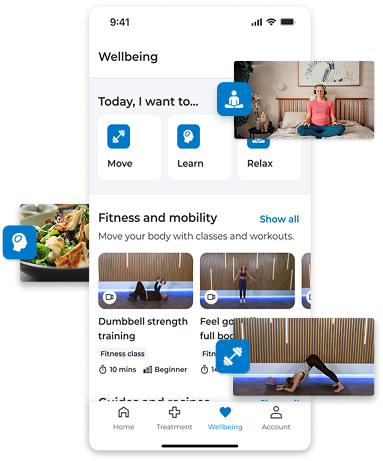
Find more fitness classes, meditations, and expert guides in My Bupa
Visit the Wellbeing and Fitness area of the My Bupa app to access content like:
- Meditation: ‘Focus your thoughts’ or ‘Begin your day with calm’
- Fitness class: ‘Yoga to love your body’
- Expert guide: ‘Low-effort healthy dishes’
You can download the My Bupa app or sign in online.
Scan the QR code with your phone camera to download the app.




About HelloSelf
We’ve partnered with HelloSelf, an online psychological therapy practice providing clinically proven therapies to adults and young people.
They are led by skilled and compassionate clinicians and have a large team of Clinical and Counselling Psychologists and CBT Therapists.
