

Irritable bowel syndrome (IBS)
Key points
- IBS can cause symptoms such as tummy pain, bloating and constipation or diarrhoea
- IBS is diagnosed from your symptoms and test results, after other conditions have been ruled out
- IBS treatment includes diet changes, medicines and gut – brain therapies
What is irritable bowel syndrome?
Irritable bowel syndrome (IBS) is a common condition affecting how your gut and brain work together. It causes symptoms like tummy pain and a change in your bowel habits. IBS is often an ongoing condition that may flare up at times. But there are ways to manage your symptoms. These can include the following.
- Your bowel may become more sensitive than normal. It might over-react to certain foods or other factors such as emotional stress.
- Your brain may process pain from your bowel differently.
- Changes to your microbiome, the bacteria living in your bowel.
- Changes in how food moves through your digestive tract.
These changes cause IBS symptoms. IBS disrupts how your brain and your bowel interact. This is sometimes known as the brain–gut axis, or brain–gut connection. It can explain why things like stress may trigger IBS symptoms.
IBS is something you’re likely to live with for years, often for life. Your symptoms will usually come and go over this time. Some people’s symptoms improve over time while others get worse. Sometimes, IBS goes away on its own.
Around 1 in 5 adults in the UK are thought to have IBS. It may be even more common than this, because not everyone seeks medical advice for their symptoms. Women are more likely than men to have IBS. You can develop it at any age, but it often starts in your 20s or 30s.
Children can also develop IBS. Around 1 in 6 children of secondary school age report IBS-like symptoms. Young children may not be able to accurately describe their symptoms, which makes it harder to identify IBS.
What are the causes of IBS?
It’s not fully understood why some people develop irritable bowel syndrome (IBS). No single cause has been identified. But it often seems to be triggered by one or more of the following.
- An infection of your stomach or bowels (gastroenteritis).
- Inflammation resulting from another condition such as inflammatory bowel disease.
- Taking medicines that affect your bowel, including antibiotics.
You may be more likely to develop IBS if someone else in your family has it. But no genetic link has been identified yet.
If you have IBS, you might find certain foods or drinks trigger your symptoms. These often include:
- fatty or spicy foods
- alcohol
- caffeine
Stress, anxiety, and depression can also worsen symptoms.
What are IBS symptoms?
Irritable bowel syndrome (IBS) symptoms vary. Some people only get mild symptoms, while others have symptoms severe enough to affect their daily life. The main symptoms of IBS include the following.
- Pain or discomfort in your tummy (abdomen). You may feel this as cramps low down or in the middle of your tummy. The pain may be worse after eating and may get better after
- Changes in bowel habits, meaning how often you need to go for a poo and whether it’s hard or less firm. Around a third of people with IBS have constipation, a third have diarrhoea, and a third have a mix of both. You may also pass small amounts of mucus.
- Your abdomen may look and feel bloated. This can get worse during the day and may improve when you go for a poo or pass wind. This symptom is less common in children.
IBS can cause other symptoms too. These are common in adults with IBS, but rare in children. They include:
- feeling like you have no energy (lethargy)
- indigestion
- feeling sick
- backache
- headaches
- bladder symptoms, such as needing to pee more often and urgently
When should I see a GP?
If you’ve been getting IBS symptoms for several weeks, you should see a GP. They may want to do some tests to rule out other causes of your symptoms.
Is IBS a serious problem?
IBS is not a serious problem, although it can really disrupt your life. It’s important to rule out more serious conditions, which can have similar symptoms to IBS. These include:
- coeliac disease
- inflammatory bowel disease (IBD) such as Crohn’s and ulcerative colitis
- bowel cancer
Contact your GP if you have new, ongoing or worsening bowel symptoms, or if you have red-flag symptoms such as:
- bleeding from your bottom
- unexplained weight loss
- a lump in your tummy or back passage (rectum)
- a family history of bowel cancer
What should I do if I'm embarrassed to talk to my doctor?
Seeing a doctor when you're embarrassed | Watch in 2:08 minutes
Dr Naveen Puri talks about how to make it easier to see a doctor about a health issue when you are feeling embarrassed.
Hello, I am Dr Naveen Puri, I am one of the GPs within Bupa Health Clinics.
Today I want to speak to you about embarrassing problems you might have and what we can do if you attend one of our clinics.
I want you to know that many people feel embarrassed or concerned about speaking about certain things with their doctors, but I'm here to reassure you these are the kinds of things we deal with every day.
For me, looking at someone's bottom or their breasts or their genitalia is no different to looking at their nose or elbow.
And that's true for all doctors as we train for many years in these parts of the body and are very used to having these conversations with people just like you.
So what I would encourage you to do if you have any concerns from your perspective, be it a change in your bowel habit, be it a lump, a rash, a swelling. Something on your genitalia or a part of your body you're not particularly familiar with or feel uncomfortable discussing.
Please be assured your doctor has done it all before.
Some of the ways we find patients find it easier to speak to a doctor is to either tell the doctor you feel embarrassed up front. That way a doctor can make extra effort to make sure you feel comfortable.
Or some patients come to us with pieces of paper and will write the problem down and hand it to us. That way we can help with whatever is going on for you as well.
You may also find it helpful to ask for a specific doctor, someone you're familiar with in your practice. Or you might want to ask for a doctor of a specific gender, or background to your liking as well.
I'd also say, doctors do this every day so don't be alarmed if we ask you certain questions around your symptoms. It is purely so we can help you get the best outcome for your enquiry.
And then finally, feel free to use language that suits you as well. We don't expect you to know the medical words for things, or a name for your diagnosis. That's our job to find out for you.
So, take your time, see a doctor, and hopefully we can help put your mind at ease.
How to tell if you have IBS?
Your GP will usually be able to diagnose irritable bowel syndrome (IBS) by asking you about your symptoms, medical history and family history. IBS is usually diagnosed when your symptoms are clear, and other conditions have been ruled out.
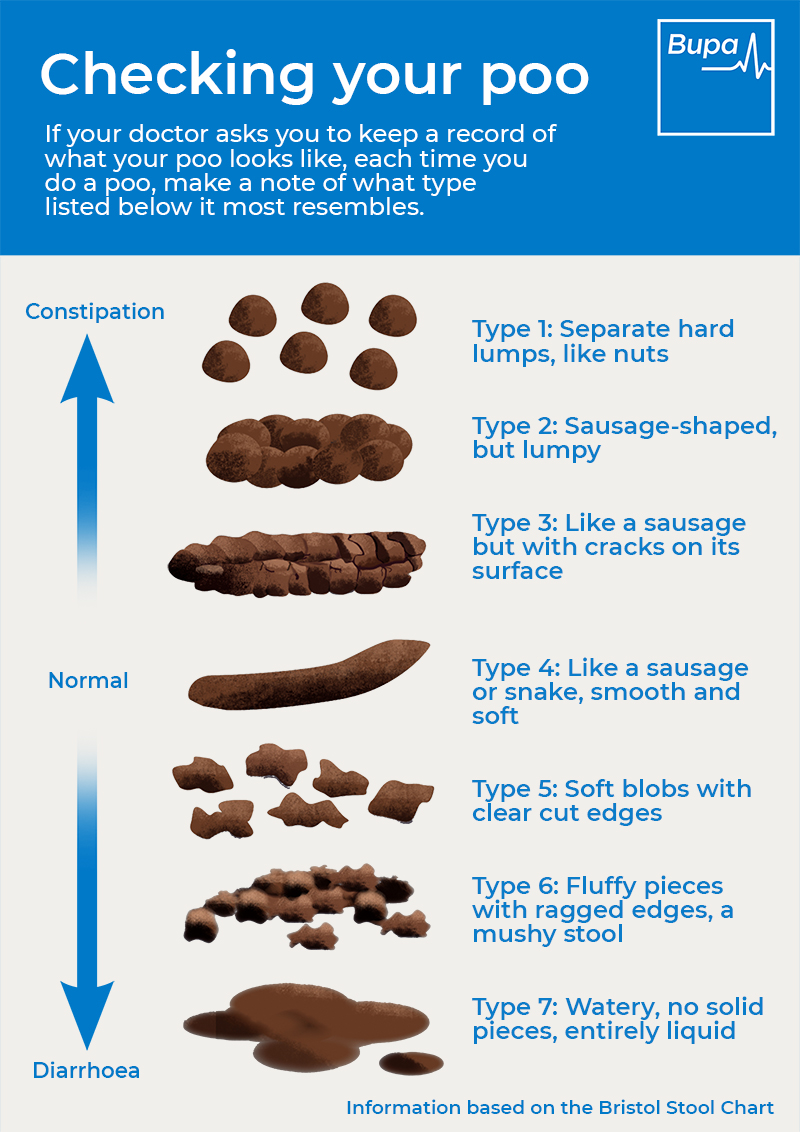
For help describing your poo, you can use our infographic.
Infographic: Checking your poo
Bupa's 'Checking your poo' infographic (PDF, 1.8MB), helps you understand what’s normal, and what is constipation or diarrhoea.
Normal poo is smooth and sausage shaped. If your poo is very hard and lumpy this might be a sign of constipation. If your poo is watery and loose this might be diarrhoea.
Your GP will want to know how your symptoms affect your daily life. They may also ask you how you’ve been feeling recently – including if you have any stress or anxiety. It can be useful to keep a record of your symptoms and any possible triggers for a few weeks to share with your GP. There are online and app-based food diaries available or you can try our downloadable symptoms diary (PDF, 1MB).
Click on the image below to download the diary (PDF, 1MB).
Your GP may also want to examine you to rule out other possible causes. This may involve feeling your tummy and checking your weight . They may also ask to do an examination of your back passage.
Your GP may ask you to have blood tests and provide a poo sample to check for other conditions, such as coeliac disease or inflammatory bowel disease (IBD). A colonoscopy is not usually needed for typical IBS symptoms without red flags, but your GP may refer you if your symptoms need investigation.
GP Subscriptions – Access a GP whenever you need one for less than £20 per month
You can’t predict when you might want to see a GP, but you can be ready for when you do. Our GP subscriptions are available to anyone over 18 and give you peace of mind, with 15-minute appointments when it suits you at no extra cost.
Which diet and lifestyle changes help with IBS?
There’s no cure for irritable bowel syndrome (IBS), but you can make changes to your diet and lifestyle which may improve your symptoms. Your GP is likely to talk you through some of these before suggesting any other treatments.
Diet advice
You may find some of the following dietary changes help. What works for you may depend on your symptoms, particularly whether you mostly get constipation or diarrhoea.
- Eat regular meals and give yourself plenty of time to eat. Avoid missing meals or leaving long gaps between eating.
- Make sure you’re drinking enough fluid to keep hydrated.
- Soluble fibre, such as oats or psyllium may help some people.
- If constipation is your main symptom, your GP, pharmacist or dietitian may suggest gradually increasing soluble fibre or trying a soluble fibre supplement such as psyllium husks.
- Increase fibre slowly and drink enough fluid, because too much fibre too quickly can make symptoms worse. If you have wind and bloating, try incorporating oats into your diet, for example, oat-based cereals.
- Linseeds (up to a tablespoon a day) can also help.
What are the worst foods for IBS?
The following foods may flare up your symptoms.
- If you have diarrhoea, avoid sorbitol. This is used in some sugar-free sweets, chewing gum, and drinks.
- Try to limit the amount of ultra processed food you eat.
- Cut back on fizzy drinks, alcohol and drinks containing caffeine – for example, tea and coffee.
- Insoluble fibre, such as wheat bran, can make symptoms worse for some people.
You also need to find out your specific food triggers. A dietitian may recommend you try an exclusion diet. This means cutting out certain foods to see if it helps.
The IBS exclusion diet is known as the low FODMAP diet. FODMAP stands for fermentable oligosaccharides, disaccharides, monosaccharides, and polyols. These are all types of carbohydrate that can be hard to digest and may cause IBS symptoms. Examples include:
- fruits, including apples, cherries, peaches, and nectarines
- artificial sweeteners
- foods containing lactose – for example, milk and dairy products
- pulses such as beans and lentils
- vegetables such as broccoli and cabbage, onion, and garlic
- wheat
A low-FODMAP diet is usually a short-term diet, followed with the help of a dietitian. It involves reducing high-FODMAP foods for a limited time, then carefully reintroducing them to find what you can tolerate. It’s not designed to be followed for a long term as it’s easy to miss out important nutrients if this diet is not managed carefully.
Some people with IBS may find that a gluten-free diet helps – this is usually because gluten containing foods can be high in fructans which some people with IBS find hard to digest. Don’t cut out any foods until you’ve seen a GP or dietitian.
Lifestyle advice
Lifestyle changes such as the following may help with IBS.
- Regular exercise may help to reduce your symptoms.
- Lose weight if you are overweight or obese.
- Manage any stress, anxiety, or depression if any these seem to be triggering your symptoms. You could try relaxation techniques such as mindfulness, meditation, or yoga.
What is the treatment for IBS?
If diet and lifestyle changes don’t help your irritable bowel syndrome (IBS) symptoms, your GP may suggest other treatments. These include medicines and talking therapies. The treatments you’re offered will depend on your symptoms and what’s causing them.
Medicines
Medicines that can help with IBS symptoms include the following.
- Laxatives, can help if constipation is your main symptom.
- Antidiarrhoeal medicines such as loperamide.
- Antispasmodic medicines such as mebeverine hydrochloride, alverine citrate, and peppermint oil capsules. These can help with tummy pain and wind.
Many of these medicines are available over the counter (without a prescription). Ask your pharmacist for advice about what you need. In some cases, your GP may prescribe medicines.
If the medicines listed above don’t ease your symptoms, your GP may also offer you a low-dose antidepressant, as these can improve the way your gut and brain interact.For IBS symptoms, your GP may consider a low-dose tricyclic antidepressant first, and an SSRI later if this has not helped.
Talking therapies
Sometimes, your GP or specialist may recommend trying a talking therapy. They may suggest this if you still have symptoms after trying the measures above. These can include:
- cognitive behavioural therapy (CBT)
- gut-directed hypnotherapy
Why is fibre important?
Fibre is a plant-based carbohydrate found in foods such as wholegrains and vegetables, also described as roughage. Many of us don’t get enough fibre in our diets.
Gastroenteritis
Gastroenteritis is inflammation of your stomach or bowels (your gastrointestinal tract). It’s usually caused by an infection.
Other helpful websites
- British Dietetic Association
www.bda.uk.com/ - Guts UK!
gutscharity.org.uk
Discover other helpful health information websites.
Did our Irritable bowel syndrome (IBS) information help you?
We’d love to hear what you think. Our short survey takes just a few minutes to complete and helps us to keep improving our health information.
The health information on this page is intended for informational purposes only. We do not endorse any commercial products, or include Bupa's fees for treatments and/or services. For more information about prices visit: www.bupa.co.uk/health/payg
This information was published by Bupa's Health Content Team and is based on reputable sources of medical evidence. It has been reviewed by appropriate medical or clinical professionals and deemed accurate on the date of review. Photos are only for illustrative purposes and do not reflect every presentation of a condition.
Any information about a treatment or procedure is generic, and does not necessarily describe that treatment or procedure as delivered by Bupa or its associated providers.
The information contained on this page and in any third party websites referred to on this page is not intended nor implied to be a substitute for professional medical advice nor is it intended to be for medical diagnosis or treatment. Third party websites are not owned or controlled by Bupa and any individual may be able to access and post messages on them. Bupa is not responsible for the content or availability of these third party websites. We do not accept advertising on this page.
- Irritable bowel syndrome. NICE Clinical Knowledge Summaries. cks.nice.org.uk, last revised September 2022
- British Society of Gastroenterology guidelines on the management of irritable bowel syndrome. Gut 2021;70(7):1214–1240.
- Irritable bowel syndrome. BMJ Best Practice. bestpractice.bmj.com, last reviewed July 2026
- Irritable bowel syndrome and diet: food fact sheet. British Dietetic Association. bda.uk.com, last review January 2025
- Irritable bowel syndrome. NICE British National Formulary for Children. bnfc.nice.org.uk, last updated June 2023
- Pediatric irritable bowel syndrome (IBS). Medscape. emedicine.medscape.com, updated June 2022
- Coeliac disease. NICE Clinical Knowledge Summaries. cks.nice.org.uk, last revised May 2020
- Crohn's disease. NICE Clinical Knowledge Summaries. cks.nice.org.uk, last revised August 2020
- Ulcerative colitis. NICE Clinical Knowledge Summaries. cks.nice.org.uk, last revised April 2020
- Coeliac disease. Definition. NICE Clinical Knowledge Summaries. cks.nice.org.uk, last revised May 2020
- Suspected cancer: recognition and referral. National Institute for Health and Care Excellence (NICE). nice.org.uk, last updated April 2026
- Bowel cancer. Cancer Research UK. cancerresearchuk.org, last reviewed June 2025.
- Irritable bowel syndrome in adults: diagnosis and management. National Institute for Health and Care Excellence (NICE). nice.org, last reviewed April 2025.
- Vasant DH, Paine PA, Black CJ, et al. British Society of Gastroenterology guidelines on the management of irritable bowel syndrome. Gut 2021;70(7):1214–40. doi: 10.1136/gutjnl-2021-324598
- Constipation. NICE British National Formulary. bnf.nice.org.uk, last updated June 2023
- Probiotics and gut health: food fact sheet. British Dietetic Association. bda.uk.com, last review July 2025
- Usai-Satta P, Bassotti G, Bellini M, et al. Irritable bowel syndrome and gluten-related disorders. Nutrients. 2020;12(4):1117. doi: 10.3390/nu12041117
- Physical activity guidelines: UK Chief Medical Officers' report. gov.uk, published September 2019
- Irritable bowel syndrome. NICE British National Formulary. bnf.nice.org.uk, last updated June 2023
- Ballou S, Keefer L. Psychological interventions for irritable bowel syndrome and inflammatory bowel diseases. Clin Transl Gastroenterol 2017;8(1):e214. doi: 10.1038/ctg.2016.69

 Member help and support